Monday, October 14, 2013

The Patty Reed Doll


My registration with the annual Donner Party Hike permitted me free entrance to the Emigrant Trail Museum. I think this was my third visit. Each time, I watch their half-hour video in the theater and each time I regret it. Why don't I learn?!

Seriously, although small, this is a fascinating collection. And there are dioramas, which I can never get enough of. History + Dollhouses = Diorama. Please don't get me started on the gigantic, ever-circling diorama at the O.K. Corral, narrated by Vincent Price. I hope it's still there.

Anyway, the museum displays a doll that apparently once claimed to be (well, the doll herself didn't claim; her humans did) the original one hidden by Patty Reed when her parents demanded they leave everything behind when they had to abandon the wagon(s).*

Let's back up. A few weeks prior, I visited Sutter's Fort. The true Patty Reed doll is on display there. I asked a docent if it was really was, because I knew there had been some controversy over the two museums' displaying of the doll. He rolled his eyes and diplomatically reported that there had been much trouble over the doll. Patty Reed left it to Sutter's Fort upon her death, in thanks for the free and generous care given to the emigrants when they finally made their way down to Sacramento--not to mention the fact that Sutter organized and funded the rescue parties--but apparently the museum at Donner Lake had it for a while and wanted to keep it. It's also traveled to Washington, D.C., to be exhibited at the Smithsonian.

This is from Gabrielle Burton's fine memoir, Searching for Tamsen Donner:

"A sign said that the original doll was on display at Sutter's Fort, but the ranger told me privately that over the years and the swapping back and forth, the original and the replica had gotten mixed up; no one knew anymore which museum had the original. I was appalled that even the experts didn't know, even more appalled when I got to Sutter's Fort and saw a shiny wooden copy of the doll that no one could possibly mix up with the weathered doll at Donner Pass. The ranger, training for his summer job, was passing on a good story, but not a true one."

I don't know much about object sharing between museums, but I believe a paper trail must accompany any shipment of an artifact. I don't buy the ranger's story that they got confused over the years--he makes it sound like they threw the doll in a cardboard box and sent it over the pass in a pickup truck. Also, possibly the two dolls have been switched since 2009 when Burton's book published, but I'd wager the Emigrant Trail Museum doll is the shiny one with overly-bright cheeks, and with a dress that looks like someone rubbed some dirt on it to make it look vintage. Who knows? I don't have an expert's eye and I believe that's why I was never asked back to be an evaluator on Antiques Roadshow. ;)

Judge for yourself. Below is the Emigrant Museum's doll in her fabricated snow habitat, and below that is the Sutter's Fort doll (supposedly the original).


I wish I had been able to obtain better images--you can google around and find excellent professional photographs. One last thought: the Sutter's Fort doll is certainly treated like she's the real deal. She's in an enclosed, temperature-controlled exhibit case (see below). The doll itself is surprisingly small, perhaps 3-4 inches.


*It's maybe just me, but I'm sure the parents knew. How can you not play with a doll you have when you're snowbound for four months, and how can your parents not notice? Perhaps they smiled privately and enjoyed letting her think she had gotten away with it. After all, in Ethan Rarick's book he closes with the lovely anecdote that after the rescue, Patty sat by the fire enacting the voices of the rescuers, using her doll. That shows that she played with the doll by voicing it--something she surely hadn't been able to suppress during the long entrapment. She was only eight, after all.


. . . . .

Thursday, October 10, 2013

The Donner Party encampment at Alder Creek

Last weekend I did the annual Donner Party hike, and wanted to talk briefly about the tent the George and Tamsen Donner family wintered in, 1846-47.

Here's the plaque that shows an artist's rendering of how they might have fashioned their shelter, by propping poles diagonally against an existing tree trunk, and covering it with the wagon canvas, branches and buffalo hides.


The only problem is, that structure simply isn't large enough. Into that space went George and Tamsen and their five children. Eliza Donner Houghton, three at the time, wrote in her book that sleeping platforms were built by driving poles straight into the ground and then lying branches horizontally: the depiction above would not permit such platforms. George Donner was an invalid from his hand-injury-turned-infection and surely had to lie down: a grown man takes quite a bit of space when resting on his back. Add in the fire--and the space around it which is too hot for human occupancy--and you've run out of room. Did the tent possibly completely encircle the tree?

I'm wondering if perhaps the poles were much longer and hit the tree further up, creating a wider, taller space. In one of the sources, I read that when visitors came--such as rescuer Clark, who spent two weeks with the Donners--there was not enough space for everyone unless if they laid in their beds. That says to me that besides the beds, there was open space.

There's also question about whether a teamster or two sheltered with them. One of the sources says that besides the nearby tent for the Jacob Donner family, there might have been a third structure for the teamsters. Given that they had tried first to construct a genuine cabin and abandoned the effort when it was four logs high, thanks to the fast-flying snow, it's hard to imagine that they bothered to make a third structure. But maybe they did...as we know, emotions were running high and maybe nuclear families wanted to withdraw and be with their own.

EITHER WAY, this was a terrible place to ride out the incredible storms of the Sierras. They couldn't have been very windproof, and they were soon covered with snow (like, completely buried in the snow, and they had to dig their way out to try to hunt or cut firewood): as the sun came out and warmed the snow, it would drip into their lodging. One source says Tamsen once despaired because her children had been wearing wet clothes for two weeks straight.

So, the tree itself...

There's a tree still extant that purports to be the exact tree the George Donner family built their structure against. This is it:


It's labeled with a sign from Peter Weddell, who says he was shown the tree by Charles McGlashan, the Truckee man who compiled survivor testimony in the first book about the Donner Party.

There are several problems with this identification. McGlashan had been unable to locate the site as late as 1879: after three decades in a woodland area with repeated snowfalls and melts, it might be pretty dicey to locate such a temporary shelter. Moreover, the area had been unceasingly picked by relic hunters and scavengers: both human and animal. The fourth relief--who brought out the sole survivor Lewis Keseberg-- reported that the Alder Creek encampment had clothing and property strewn across the snow: the camp's demise was coming as quickly as that of its unlucky inhabitants.

In 1884, McGlashan walked the Alder Creek area with Jean Baptiste Trudeau and still couldn't determine the precise spot for George's shelter. The same was true in 1892 when John Breen visited McGlashan.* Weddell may have misunderstood McGlashan.

Another key bit of data that had been forgotten and then rescusitated by Donner Party historian Kristin Johnson: the mention in Eliza's book that relief party men had cut down the tree their shelter rested against, for firewood. If so, there would be no tree to label and revere. This is problematic too: how could they remove the tree that everything rested upon, without the entire structure collapsing? Is it possible they cut the tree farther up, above the snow line and above where the supporting poles rested?

One of the frustrating things about this story is that much of the information is confusing or in some cases contradictory.


Meadow at Alder Creek


Guide Carrie Smith holds up a tiny piece of bone found at Alder Creek


There has been a lot of archeology in the meadow. Our guides told us that a hearth was located: of course, nothing so blatant as a circle of stones, but instead an accumulation of orange dirt that indicated long-term fire that changed the composition of the soil (I'm only halfway through An Archeology of Desperation  or I'd probably be able to write something smarter). Long-term fire is key: the Donners were here for four months, but many others have trooped through the area and built their fires. The discovery of the hearth almost certainly means one of the Donner sites was found: but which one? The site is not labeled and that's intentional. After a century and a half of people disturbing the site in their quest for Donner money or Donner relics, they want to protect it. An object, once taken from its original resting place, is of no use to an archeologist; it must remain in situ.

Sidenote: the guides told me of a similar situation, the nearby petroglyphs by the Washoe people. After a decision to plaque it and mark it for others, the holy site has been ravaged. "We have a sign saying please don't climb on the rock, and then I see 20 people up there," said one of the guides sadly.

So...the bones. They located thousands of fragments of cooked bone--and not one of them was human. That fact, when first released, caused a sort of hubbub where people jumped to the conclusion that cannibalism had not taken place at Alder Creek. The important distinction is that only cooked bone (and the guides talked about the "pot polish" on the bones, showing they had been boiled and stirred so much that they took on a surface from the metal pot) can survive. An uncooked bone--and anecdotal evidence seems to suggest that viscera were removed, and tissue cut from the bone, for consumption--would not have survived all these years.


My shadow: holding a bone fragment

 There was a little Tupperware that went around our group, holding bone fragments and even a piece of clear bottle glass. So remarkable to hold these things!


Disclosure: not my hand


Shoemaker's arm? No, just a branch


*An Archeology of Desperation: Exploring the Donner Party's Alder Creek Camp, edited by Kelly J. Dixon, Julie M. Schablitsky and Shannon A. Novak. This very recent (2011) book was recommended to me by Kristin Johnson, and represents the latest knowledge about Alder Creek, fortified by the archeological digs performed there.


Tuesday, October 08, 2013

Getting to the Donner Party Hike 2013


Last weekend, I returned to the annual Donner Party Hike which I last did many years ago, when we still lived in Oakland. This hike (which has now evolved into many different hike selections over two days, depending on your preferred level of strenuousness) follows part of the emigrants’ trail. I remember last time spending all day hiking to sites where the guides pointed out scars on tree trunks, from where the wagons scraped through, and where we saw the infamous Roller Pass.


Our group: there were maybe 25 of us

 This year I chose to do the hike (maybe more like a tour--not much walking involved) that focused on Alder Creek, the separate encampment area seven miles from Donner Lake, where the two Donner families and a few others set up their fragile domiciles to wait out the winter of 1846-47.

Tree long thought to be where Tamsen and family built shelter against

I was obliged to leave the house at 6:45 a.m. in order to get there in time. Just like the Donners leaving Springfield, Missouri, I got a bit of a late start. My delay was only 10 minutes, but still…

Barely a mile from my house, I looked down at my gas gauge. I had a third of a tank. Definitely enough to make it there, but maybe not enough to make it back? I reasoned I could fill up on the return trip, but maybe I’d be rushing even more then, so I stopped to fill up my tank. This might be akin to the Donners during one of their many time-killers: maybe the reason they were so late starting on the trail was that they stopped for the equivalent of gas. Remember Tamzene wrote that, “Indeed, if I do not experience something far worse than I have yet done, I shall say the trouble is all in getting started.”

Plaque: how the shelter may have been constructed against tree trunk

Now, you’ll think I’m making this up for purposes of parallelism, but as I drove along I began to feel excruciatingly hungry. I had left the house without breakfast because of the early hour, reasoning I’d grab coffee and something quick along the way. But I was really, really hungry. I let the feeling sit for a while, thinking it was good practice to imagine how the Donners felt this way for months on end. Ultimately, I had to stop. I was trying for a breakfast burrito, but driving around the strip mall I couldn’t locate the intended purveyor, so instead I went to a donut shop in that outlet. I picked a cake donut, thinking it looked a little healthier than its fluffier peers (I got it chocolate frosted; I’m not a martyr), and some decaf coffee and was back on the road.

Close-up of tree: aging Peter Weddell sign and Earl Rhoads blaze
I made good time, but my “Wasatch Mountains/Great Salt Desert” was the fact that I couldn’t determine the proper exit off the highway. I got off and suddenly somehow thanks to a roundabout found myself back on it. I drove, I looked at the time, I started to panic. I pulled into a ranger station and got some good advice, unlike the Donners. I made it to the hike rendez-vous with 15 minutes to spare.

At their registration table ("Johnson Ranch")? Coffee and donuts. Ha!

Their restroom was completely locked up thanks to the government shutdown. I had to walk into the woods and wonder if I was watering the same soil the Donners had.

Where I guiltily ate almonds. Excellent guides: Carrie Smith, left, and Gayle Green


And there the coincidences stop. I was not entrapped at Alder Creek. Snow did not fall. No one’s hand was injured. Buffalo hides were not eaten, nor were shoestrings nor fire rugs. I had brought a little sack lunch in my backpack that satisfied. I did feel like a turncoat standing there at the tree once thought to be the one the George Donner family had built their structure against, munching on a handful of almonds. If I could’ve slipped that food back in time, believe me, I would have. 

This young tree was planted by Donner descendants
This story pulls at my gut, has me obsessively reading three books at a time on the topic, carrying on a wonderful email correspondence with a highly-regarded Donner Party historian, and even giving my poor community college students writing assignments like, “Write a letter to Lansford Hastings, pretending you’re a survivor.”

Not too long ago, I told my husband a particularly disturbing anecdote from the Donner Party annals—not about cannibalism; oddly enough, I don’t find that aspect that compelling or interesting—and he said, “That’s why you can’t sleep at night. You read this stuff right before you go to bed.” He was, well, suggesting I stop doing so. It was a gentle suggestion on his part, so I didn't say what I thought, which was, “If you want me to stop reading about the Donner Party, then you married the wrong woman!”

He just wants me to sleep soundly. In our warm bed, where we can hardly even hear the wind blow outside, where a few rooms away cupboards await us, filled with food.


. . . . .

The serendipity behind The Witch's Trinity

At the Historical Novels Society, I met a wonderful fellow writer, Stephanie Renee Dos Santos. Recently, she approached me because she was writing a series of articles on serendipity in fiction. She had looked at my website and learned that I had not known about my witchcraft ancestor, Mary Bliss Parsons, until after I was already underway with my novel about witchcraft, The Witch's Trinity. That counts as an item of uncanny serendipity, and so she included me in her series--which I think is extraordinary. Although I'll link to my post in the series, I highly recommend all of them! They are available through the Historical Novels Society website, here.

Enough time has elapsed that I think it's okay to go ahead and re-post here. Thanks again to Stephanie for including me in the series.

Stories of Serendipity: Writing Historical Fiction Series Featuring author Erika Mailman

Stephanie Renee dos Santos

Welcome to the third week of our series where writers share stories of serendipity and synchronicity while writing, researching and publishing historical fiction, and the exploration of possible reasons for such occurrences.

This Sunday we are delving into the world of the female shaman: amulets, witches, magic.
Come read on…

Muiraquita
 Muiraquita amulet

My final tale to impart for the series has to do with an Amazon talisman: a green frog amulet. The last third of my novel, Cut From the Earth (working title), takes place in the Brazilian Amazon in 1756, at a time when Catholic missions of multiple sects proselytized along the immense river and her tributaries. Writing my book’s first draft, I had given a fictional female shaman character a lichen-colored stone necklace in the shape of a frog and located the scene of her appearance in the Tapajos River region of the Amazon, at the historically documented Jesuit Mission of Tapajos– all things, but the mission, I thought I’d made up. But after completing my novel’s first draft, I flew to the great river mouth of the Amazon, to the town of Belém, to travel the river section of my book, to take in the surroundings and further investigate the places of my story. And while in Belém I came across a museum I hadn’t read about in any literature prior to my trip. While visiting the museum’s displays, I came across a story that explained that the indigenous women of the Tapajos River were known to possess jade-colored, frog-shaped stone pendants called a muiraquitã and that the gemstone it was made out of, nephrite, was found only in the Tapajos region of the Amazon. Bewildered, dumbfounded, I stared at the physical example of the amulet of my character in the showcase and read about her, gaining more insight into the powers associated with the real life revered stone and its holders.

It is my pleasure to hand you over to Erika Mailman, author of The Witch’s Trinity, and her uncanny and bewitching story of serendipity and coincidence…

EM

“My novel The Witch’s Trinity was well underway when I got an odd email from my mother. “We’re related to a witch!” she reported. I was stunned. All my life I’d been fascinated by witchcraft, and had even pretended that a particular name on the family tree that hung in the stairwell was the dark mistress in question. My mother had learned about Mary Bliss Parsons, our ancestor, via a friend who sent a link to an extraordinary website UMass website  which contains testimony—both typed and scanned-in originals—from Mary’s neighbors, condemning and protecting her. Mary was accused of myriad crimes, such as going into the river and coming out dry, and causing a farmer’s sow to die when formerly she was a “lusty swine and well fleshed.” She dispatched a rattlesnake to bite an ox, made a young boy trip in the woods and hurt his knee, and made spun yarn diminish in volume after it had been sold. That’s just a minor catalogue of her doings.

calling down rain de lamiis1489
Calling down the rain”: in the 1489 edition of De Lamiis, witches create
a brew to bring down the rain.

Two things were extraordinary to me. The first was that I had never heard of Mary Bliss Parsons before, and we were a family that was very proud of our heritage…including Mary’s husband Cornet Joseph Parsons, a founding father of Northampton, Massachusetts, where Smith College is today. We knew all about his life, but not one word about his wife’s witchcraft accusations—yes, plural, because 18 years after she was acquitted from her first trial, she was accused again. There’s even some evidence she may have faced a third accusation, but she died under the label “innocent” as an old woman, aged 85. Why was her story suppressed in the oral pass-down of our family history? And why would I learn about it while I was in the middle of writing a novel about witchcraft?

The other extraordinary thing to me was that I learned about my own ancestor through an educational website. I shiver to think of how our technology would appear to the people of 1656, the year of Mary’s first witchcraft trial. The testimony, handwritten by the court’s recorder, has now been scanned in and we can examine his every quillstroke. How is it possible that the deeds of a town consisting of only 47 households—Springfield, Massachusetts—are now freely available to a world of 7 billion people? As she died, she must’ve thought the rumors and tensions would die with her. Instead, they have been resuscitated and revived for a new audience. That is its own kind of witchery.

I’m at a loss how to explain such a coincidence. I kept using the word “uncanny” at the time (which Merriam-Webster asserts means “seeming to have a supernatural character or origin”). I wrote The Witch’s Trinity in nine months; how unusual that after decades of not knowing about my ancestor, I learned about her in this very narrow window of time when I was focused on the unfair and cruel situation she faced?
My editor asked me to write a brief essay about Mary Bliss Parsons, and it is included in my


 paperback cover US

novel’s Afterword. I appreciated the official request to learn more about my ancestor. It was sobering to learn that she was outspoken and freely dispensed advice, and that probably spelled her downfall. For instance, she scolded a neighbor for whipping borrowed oxen so hard—surely not a woman’s purview—and he accused her of causing his own ox to die. She was said to be “a proud and nervous woman, haughty in demeanor and inclined to carry things with a high hand”: in short, a woman who was confident and didn’t meekly bow her head as the culture then expected. I’d like to think my book is a form of apologia for Mary. She would doubtless fit into today’s world far better, and it’s sad that her era did not support her strength.”


. . . . 

Saturday, September 21, 2013

Interview with Kathleen Kent

-->

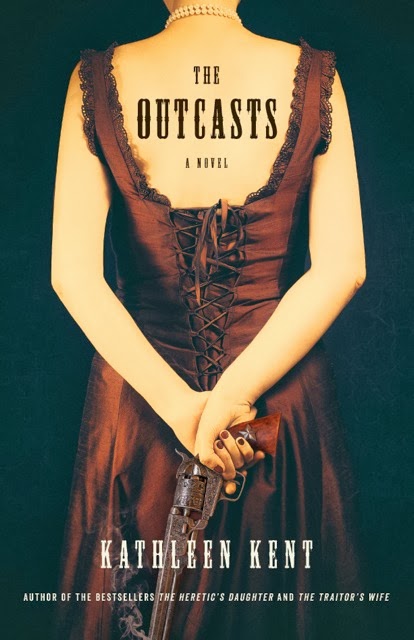
I’m so proud and happy to host a Q&A today with Kathleen Kent. Kathleen’s a fantastic writer and her topics are near and dear to my heart: witchcraft (The Heretic’s Daughter), Colonial Massachusetts (The Wolves of Andover, also titled The Traitor’s Wife, but I love the consonance of the first title), and the lawless Old West (her latest novel, The Outcasts, which releases on Sept. 24, three days from now. Order now!)

Kathleen gave me an ARC at the Historical Novels Society conference in June. I devoured it and loved it; it really is a wonderful book and filled with harrowing scenes and lots of good plot twists. Here is our interview:


Q: In your new book The Outcasts you write two different character’s storylines: Lucinda Carter, who escapes a brothel and journeys to meet up with an old acquaintance, and Nate Cannon, doing a stint with the Texas Rangers. Was it difficult to write from a male perspective?

KK: No, I didn’t find it difficult at all. My second novel, The Traitor’s Wife, was written from various male points of view, as well as female. We all have masculine and feminine traits and intuitions, and part of the joy of being a writer is trying on all of those personas. I also think growing up with a dad who was a great storyteller of Texas legends helped to plant the voices in my head. From him I adopted the pride, awe and, at times, despair for the wild, rough-edged and dangerous men and women who settled the early frontier.


Q: What kind of research did you do to understand the psychology of someone who
knows their lover does despicable, harmful things to others—and yet still fiercely loves and admires them?

KK: There are so many stories in the history books, ancient and modern, of otherwise reasonable, intelligent women falling for unscrupulous men. Certainly it still happens today. All you have to do is open the paper (or click on the story while on-line) to see the destruction and carnage as a result of a woman aiding and supporting a bad man on a crime spree. As a character study, it was interesting to develop Lucinda’s growing dependence on her lover and the way she rationalizes his character and behavior. In a time when women had---and in many places still have---so few choices in their own destinies, it was easier and at times safer to turn a blind eye to misdeeds.

Q: We talked about your striking cover art in person. Can you talk a little bit about your input, and your feelings about the image? Is that gun *the* gun?

KK: I’ve been really fortunate in that regard as I’ve had a lot of say in the publisher’s choosing the cover art for my first two novels. For The Outcasts we discussed concepts first and then started looking at images. When I was shown the image that everyone seemed to love the most, I was equally enthusiastic about it. . .all except for the gun the woman is holding. Originally, the gun in the photo was a flintlock pistol from the late 1700s. It was a beautiful weapon, but completely inappropriate to the era. I sent back some images of Colt revolvers and, through the magic of photoshopping, the gun was magically transformed. If there’s one thing Texans know, it’s their guns! The gun that Lucinda carries in the novel is a small Remington derringer, effective in close quarters, but too small to look impressive on a book jacket.

Q: I know from your blog you’ve been interested in rumors of buried treasure in Middle Bayou. Did you have a similar fascination with the Texas Rangers?

KK: Growing up in Texas I was fascinated by the legends of the Texas Rangers. One of my father’s distant relatives, Thomas Hickman, is in the Ranger Hall of Fame and was most noted for keeping law and order in the wild North Texas oil-boom towns where my dad grew up. The Rangers of 19th c. Texas seemed to be a law unto themselves and were left unchallenged by government and welcomed by the settlers of the Republic to pursue their own unsanctioned and often violent methods of keeping the peace. After the Civil War, the Rangers were disbanded for a short while, but they continued to protect and serve unofficially, their experience and loyalty to the brotherhood often times more effective than the newly formed Texas State Police in keeping bushwackers, carpetbaggers, cattle and horse thieves at bay.

Q: What are you working on next?

KK: I have two projects that I’ve begun and I’ll have to decide soon which manuscript to finish before the other. The first is a historical novel set in 1910 in a Pennsylvania coal town and involves a mining accident and missing children. The second is a contemporary novel based on a short story, “Coincidences Can Kill You”, that will be published this November in Dallas Noir, an anthology of crime stories by Dallas authors.

Thanks so much, Kathleen! I wish you a world of luck with your launch in a few days. I'm sure we will be seeing this one on the NYT bestseller list as well. 


. . . .


Tuesday, September 03, 2013

Maiden Lane Press launches today with Moonrise

 
A literary agent who used to be on the publishing side jumps the fence and decides she can do it as well if not better than the big guys. That’s the story of Marly Rusoff, who created Maiden Lane Press specifically to release Cassandra King’s latest novel Moonrise.


That novel, a retelling-of-sorts of Rebecca by Daphne DuMaurier, launches today!

Rusoff held a design competition to create the imprint’s gas lamp logo. She and her partner Michael Radulescu pored through listings of gods, goddesses and titans to find a name for their press, finally fastening on Maiden Lane, an evocative place name.

Today’s book launch is a hopeful testing ground for Rusoff. If all goes well, she may begin publishing her clients’ backlists or other items of interest, such as a commencement speech given by Arthur Phillips, author of Prague, or Jonathan Odell’s first novel, now out of print.

More than that, though, Moonrise is dedicated to Cassandra King’s sister Nancy, a teacher who died just as the book was finished. Both Daphne DuMaurier and Nancy would be proud of their very different but personal associations with this novel, one readers are saying is King’s best book yet.

Here’s a description of the book from the author’s website:

Helen Honeycutt is just getting her life back on track after a bitter divorce when she meets Emmet Justice, an attractive widower still grieving for his late wife, Rosalyn. Their sudden marriage sets off a maelstrom of resentment and ill-will among Rosalyn’s family and friends. Hoping to mend fences, the newlyweds plan a summer at Moonrise, Rosalyn’s historic estate in the Blue Ridge Mountains. Moonrise is known far and wide for its unique nocturnal gardens, which have fallen into ruin since the death of its mistress.

Like the heroine of Daphne DuMaurier’s classic romance, Rebecca, Helen becomes obsessed by her predecessor, who lives on in her house and gardens and the hearts of those who loved her. Not only does Helen fail to measure up to the beautiful and accomplished Rosalyn, she doesn’t fit into her world, either, an elite enclave of well-to-do summer people. Even the gardens exclude her, since their secrets, passed down by generations of gardeners, died out with Rosalyn. When it becomes clear that someone in Rosalyn’s close-knit circle of friends is determined to drive her away, Helen wonders if she can trust anyone, even her husband. As the sweltering summer draws to an end, Helen must uncover the secrets of the past in order to establish her own identity apart from the woman she replaced.

The book is available in hardcover or Audible format.

King is the wife of author Pat Conroy. A few prepub blurbs:

“A suspenseful Gothic that gives a nod to its predecessors while still being fresh”--Publisher’s Weekly

“Moonrise is a fantastic, not-to-be-missed novel."-- Anne River Siddons, author of The House Next Door

"I read Moonrise in a single greedy gulp.” -- Meg Waite Clayton, author of The Wednesday Sisters

Congratulations to Cassandra, Marly and Maiden Lane Press!


Friday, July 19, 2013

Claws of the Cat launch!

My friend Susan Spann held her debut novel's book launch last night at Face in a Book in El Dorado Hills, California. It was a fantastic evening and I'm so glad the world now gets a chance to read her incredible book, Claws of the Cat. It's the first in a series featuring a medieval ninja crime-solver, Hiro Hattori, and his Portugeuse priest sidekick, Father Matteo. Here's a taste of the evening, rendered in photographs!
 

At Chantara Thai beforehand.

A group of us ate beforehand, steps away from the bookstore, at Chantara Thai. It was lovely to get a chance to meet Susan's parents who had flown up from Southern California for the event, as well as other friends of Susan's I hadn't met before. What a nice group of people. And thank you Paula and Spencer for dinner!
Just before the reading. Look what a nice display the bookstore made behind her!

Face In A Book is a really great bookstore, and I'm so happy Susan had her launch there. It's a wonderful independent bookstore that supports its local authors.

The author with scads of her books; the piles were depleted ere the night was over!
Susan read from Chapter Four of her book and then answered questions from the audience. I asked a question I already knew the answer to, because it's so impressive. I asked, "How far out have you plotted this series?" THIRTEEN BOOKS INTO THE FUTURE, PEOPLE! I can't even conceive of that kind of planning. Frankly, I don't know what I'll be doing 13 days from now, let alone 13 books from now. Susan's  contract with Minotaur is for a trilogy but I have no doubt whatsoever they will be signing her on for the rest soon.

Adjourned for coffee afterwards with friends
Afterwards some of us walked a block away to Starbucks (I love Town Center). I made everyone display their books on the table...and poor Susan had to sit on the floor. Not pictured are two other sweethearts who came: Diana and Heidi.

Postscript 1:
My husband read the first chapter the next morning, standing in the kitchen as he oversaw French toast production. He said, "Her prose is like Hemingway." I kid you not!

Postscript 2:
Someone else in the household thought the title was "Laws of the Cat" (which is funny because Susan is an attorney), and proceeded to list what those might be:
  • Do not scratch a human
  • Always brush your fur straight
  • Always put the right catfood in your catbowl
  • Always do what the police cat says

On that note, good night! Congratulations, Susan. I couldn't be prouder or happier for you.


. . . . . 

Thursday, July 11, 2013

Historical Novels Society conference 2013: The Vinoy

The Vinoy at night, from the waterfront

I previously posted about the panel I served on, along with Kathleen Kent, Mary Sharratt and Suzy Witten, three fabulous and fascinating novelists who write about witchcraft. Now I'd like to talk about the Vinoy Hotel, where the conference was held....because it really was an amazing hotel.


I kept expecting to see Danny on his Big Wheel coming down the hallway
It was very Floridian, with pink shell color on its Art Deco facade, but it also gave me Overlook overtones. It was a hotel of the same era, where people would come for the entire season and attend those balls with live orchestras.

Chihuly glasswork in the lobby case
In the lobby (besides an incredible Chihuly display), a collection of photos showcased the hotel's history and its astounding multimillion-dollar renovation. It had spent 18 years empty; there's something so evocative to me about formerly grand places in decay (viz., the Titanic).

The Chihuly Museum is here in town (the town being St. Petersburg, Florida). I really wanted to go. I love Chihuly, who I first encountered upon entering the San Jose Museum of Art, where he has two enormous hanging glass pieces in the front lobby...which made me think in an earthquake, I'd know exactly where not to stand. And then in the Bellagio in Las Vegas, I marveled at the magnificent Fiori di Como ceiling near the registration desks. Finally, Dale Chihuly gets sort of bandied about in a novel I'd just read called Where'd You Go Bernadette, which I loved beyond speaking, so I was really excited to see the evidence of his handiwork here and there in the hotel. Unfortunately, I wasn't able to swing visiting the museum although I walked right past it. Nor was I able to see the Dali Museum, whose architecture is said to be one of the top 10 buildings you have to see before you die. Well....now I don't have to die, right?

The Chihuly chandelier in the Vinoy ballroom...I was not the only one to see a Medusa in it

Lovely architectural details abound in the bar. Because that's what matters in a bar.


The hotel's bar was really lovely and I'm happy to say I spent a fair amount of time here chatting with friend and fellow novelist Vanitha Sankaran and then later....dancing to the DJ with a bunch of other booty-bumping HNSers. I didn't know until the next day that it was a wedding party. Without the veils and bouquets, who can tell?

Darn, it's out of focus. This is the muy cool lobby.

Angry at myself for not getting a better shot of the lobby, the heart of the hotel after all. This is the room where you try to rally after a redeye flight, when it's 6 a.m. their time, 3 a.m. your time, and your room won't be ready for another couple hours. Luckily, there's a veranda with a great view of the boats in the marina so you can slump and contemplate dry heat versus humid heat until your room is ready.

But the room is worth waiting for!

My view as I walked in....why, are those chairs for reading? How lovely of you, Vinoy!

View from other side of the room. Love the lime walls with magenta chairs.


The room was gorgeous and I contemplated sleeping on each bed on alternate nights. Instead, I stuck with the one by the door so I'd be aware and ready when Jack Torrance came with the ax. Actually, the Vinoy is reputed to be haunted. When I made my reservation, I specifically asked for a room that was not haunted. The woman laughed and said, But we need fresh souls from California.

She didn't really say that. I would have loved it if she had.

A room with a view: Helena Bonham Carter, eat your heart out!
I had two windows with lovely views that really underscored I was in Florida. Palm trees! It's hard to tell, but the aqua square is a lovely fountain, and the white chairs are all set up for the wedding whose dance party would be later overtaken by bookish drunks on a tear. I kept looking at this picture, wondering what the odd pale business card looking thing is, with the blue stripe hanging down, towards the left of center. I just figured it out: it's my necklace thing, what's it called? That you wear around your neck so you can get into the conference? And the blue dangler said "Speaker" on it. It had flipped around backward to be immortalized in the window reflection.

I think that's all for the Vinoy. In my next post, I'll share images of some of the sessions I attended.


. . . . .

Friday, June 28, 2013

Ann Marie Meyers: Up in the Air


I'm going to take a little break from the wrap-up posts about the Historical Novels Conference this last weekend in St. Petersburg to host an old buddy.

Ann Marie is someone I remember fondly from the old days at the San Francisco Writers Workshop. We both attended religiously about six or seven years ago. Now she has a children's book out called Up In the Air. Isn't that a gorgeous cover?

I'm very happy to host her today with a little Q&A about the process of writing this book and her career in general.


1)                What inspires you to write

I get my inspiration from just about anything. Something I read, or overhear; a thought that flashes through my mind, the look on someone’s face; my dreams, especially my dreams. Sometimes I just let my mind go blank and write down the very first thing I think of and then see where that takes me. My very first book was written this way.

2)                What about Up In The Air. Which form of inspiration did that take?

Surprisingly, neither of the above. The idea came to me while I was meditating one day. That was the first and, as of now, the last time such a thing has happened to me.

Ann Marie Meyers


3)                Did you always want to write?

No. Definitely not. I have always enjoyed reading. I devoured hundreds of books when I was young, and I loved writing essays in school and letting my imagination fly. Then, one day, (in my late teens actually) to my utter shock, I started a journal and the very first words I wrote were: “I want to be a writer”. I have no idea where that thought came from, though I didn’t actually start to write until much later, and even then I didn’t embrace the idea at first. I resisted.

Some of the famous authors I studied in school (eg: James Joyce and D. H. Lawrence) were so unhappy I wanted no part of it. I wanted to be happy, unfettered by depression (idealistic but true).  Eventually though, over time, I learned to accept the fact that I wanted, even needed, to write and create stories.

4)                And children’s books? How did you get involved in that?

Quite by chance actually. I remember seeing advertisements appealing to people to write children’s books, but I never paid any attention to them. After my daughter was born, I began having thoughts about what she might like to read but it wasn’t until she was about 3 years old that I actually wrote my first children’s book, Up In The Air.


. . . .