Showing posts with label witch. Show all posts

Monday, October 29, 2018

Malleus Maleficarum, the Witch Hunter's Bible


Modern edition of Malleus has a demon riding backward and a witch being
burned at the stake. My novel shows a similar demon on the cover.


In the very fun movie The House with a Clock in its Walls (based on the classic novel by John Bellairs, which I loved as a child), the warlock character Jonathan Barnavelt starts searching for books to help out in a bad situation. One of the books he's trying to find is the Malleus Maleficarum, an actual book that is known as the Witch Hunter's Bible.

It was written in/around 1486 by two German inquisitors, Heinrich Kramer and James Sprenger, who were wandering through Northern Germany to help towns with their witchcraft problems.

The title translates to "the Hammer of Witches"—i.e., the weapon which you can use to hammer them downyou can see the root of "mallet" in "malleus." 


Original cover of the Malleus Maleficarum

The book was written to assist if the two friars couldn't happen to be there in your village at the time a witch was ruining everything for everybody else. Says translator Montague Summers, "The Malleus lay on the bench of every judge, on the desk of every magistrate. It was the ultimate, irrefutable, unarguable authority."

This book is still in print today.

It discusses the things witches do (just flipping through, I am seeing chapter headings like, "How they are Transported from Place to Place" and "Here Followeth how Witches Injure Cattle in Various Ways"), how to question them, and how to pass sentence on them. It contains very legal language and is deadly serious in its pragmatic approach to an otherworldly crisis. The language in the sentencing parts is actually so legalistic and long-winded that I hesitate to include an excerpt! 


In this 1591 woodcut, witches bring children to the devil.


The book lays out 35 kinds of questions to put to a witch. Here's the heading for Question 34: "Of the Method of passing Sentence upon a Witch who Annuls Spells wrought by Witchcraft; and of Witch Midwives and Archer-Wizards."

It's like The Handmaid's Tale meets Dungeons and Dragons. The witch midwives "surpass all other witches in their crimes" and the archer-wizards (as in, archery) "constitute the graver danger to the Christian religion in that they have obtained protection on the estates of nobles and Princes who receive, patronize and defend them." Archer-wizards enchant weapons so they don't work right, while witch-midwives either kill the child in the womb or offer up the newborn to the devil (an example of this is seen in the woodcut above).

The book is a lightning bolt of shocking entry into the superstitious, ignorant medieval world. In my novel The Witch's Trinity, set in Germany during this time period, an elderly woman is so indoctrinated in this cultural mindset that when she is accused of witchcraft, she isn't completely sure if she's innocent.


As I continue to flip through my copy of the Malleus, I see passages I highlighted just because they blew my mind, and handwritten marginal notes where I had to vent. In a random flip-through, here is a pretty interesting section:

"An example was brought to our notice as Inquisitors. A town was once rendered almost destitute by the death of its citizens; and there was a rumour that a certain buried woman was gradually eating the shroud in which she had been buried, and that the plague could not cease until she had eaten the whole shroud and absorbed it into her stomach."

Yikes, rumours can be so vile! Hungry corpses are the worst!

If you're curious how it ended, the city's governor caused her to be dug up. The Podesta (an Italian official) cut her head off with his sword, "and at once the plague ceased." This anecdote is compelling not only for its eerie image of the woman eating fabric in her grave, but also because her exhumation was official and endorsed by the highest levels of city government.

If you're wondering why calmer heads didn't prevail, the very first part of the Malleus establishes that not believing in witchcraft constitutes heresy. So, to save your own skin, you'd become a believer, too.

I hope you've enjoyed this look at the very, very dark recesses of medieval justice. And hey: please vote in November!

*Note: as of this writing (Oct. 30, 2018), The Witch's Trinity ebook is on a Book Bub sale for $1.99 until Nov. 4. It is that price across all platforms (Kindle, Nook, Google Books, Kobo, etc.). Here are the links:

“A gripping, well-told story of faith and truth” (Khaled Hosseini, author of The Kite Runner): When a small German town falls on hard times, the townspeople blame
witchcraft — and an elderly woman whose mysterious visions leave her questioning what’s real… “Beautifully written” (San Francisco Chronicle).
 
Amazon
https://r.bookbub.com/et_active_check/83319?affiliate_batch=0&affiliate_label=a&affiliate_variant=author_deal_alert&mailing_id=25233&region=1&retailer_id=1&subscriber_id=15064178
 
 
Barnes & Noble
https://r.bookbub.com/et_active_check/83319?affiliate_batch=0&affiliate_label=a&affiliate_variant=author_deal_alert&mailing_id=25233&region=1&retailer_id=2&subscriber_id=15064178
 
 
Apple iBooks
https://r.bookbub.com/et_active_check/83319?affiliate_batch=0&affiliate_label=a&affiliate_variant=author_deal_alert&mailing_id=25233&region=1&retailer_id=3&subscriber_id=15064178
 
 
Google
https://r.bookbub.com/et_active_check/83319?affiliate_batch=0&affiliate_label=a&affiliate_variant=author_deal_alert&mailing_id=25233&region=1&retailer_id=4&subscriber_id=15064178
 
 
Kobo
https://r.bookbub.com/et_active_check/83319?affiliate_batch=0&affiliate_label=a&affiliate_variant=author_deal_alert&mailing_id=25233&region=1&retailer_id=5&subscriber_id=15064178


Photo credit: Petra Hoette


Links:

Random House: http://bit.ly/2BZrJf4
Barnes and Noble: http://bit.ly/2dpMYKc

Follow Erika on Twitter: @ErikaMailman
and on Instagram: @ErikaMailman


. . . .

Monday, June 19, 2017

The cover that never was

Occasionally I'll google to see if there are any reviews I've missed. Imagine my surprise when I saw mention of my book on a book design site. I clicked through and could see that along with the hardcover U.S. design, there was a jacket there I hadn't seen before. I could only see a small portion of it through a circular thumbnail and, wouldn't you know it, something was up with my computer and I couldn't load the full image.

Here's what I saw:


So I emailed the designer Laura Duffy and we had a lovely exchange. And the next day, I was able to click through and see the beautiful book cover in its entirety.


Isn't that gorgeous? For an author, book design is a really important thing. I know I reject books when I'm browsing based on their jackets, and pick up something I maybe wouldn't otherwise if the look is arresting. It's also a very interesting process to see someone else's vision of your book: kind of intimate in a way. I know it's rare that a designer would actually read the book but nonetheless that person has been given descriptive materials and creates their own vision of what the story is. It's maybe a brief taste of what it would be like to see your work on the screen. At any rate, I loved what Laura created.

I think the colors are attention-grabbing, the element in the middle looks like a rune-meets-a-torture-device (very fitting for my book!), it's allusive to a devil's pitchfork, and ghosted behind it all I can see wording from the Malleus Maleficarum, a Witch Hunters Bible from the medieval period, and elements from a design that appeared on the book's galley but was ultimately rejected. I LOVED THAT COVER. Here it is:


It has all the Rorschach test value of "what do you see in the flames?" and is dangerous and would've been so beautiful with the promised gold foil in different colors for the fire. Since my book takes place during the era when witches would be burned at the stake, this is a haunting design. Laura, you knocked it out of the park with this one! I was told at the time that it looked too science-fictionish and instead this quiet yet still lovely design from Laura was used:


I have been lucky that the book then went into paperback with a new design, that a British edition was created with its separate hardcover and paperback designs, and that an audiobook was recorded in England with again a different cover. Seeing each one of these designs brought a frisson of delight to see the designer's take on what was so very personal to me. Speaking of covers, I have a reveal I'll be doing on Wednesday for a new project. Stay tuned!

Laura's design work is beautiful. See more of it here


. . . .

Monday, March 13, 2017

Kathleen Kent's remarkable ability to turn on a dime


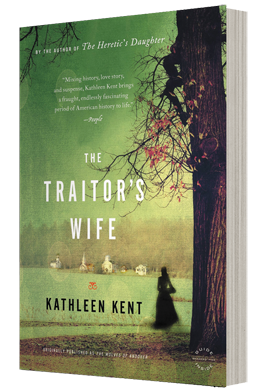
For many years, it's been my honor to track the career successes of someone who has become a friend. Kathleen Kent, who burst onto the scene in 2007 with an incredible historical novel about her ancestor Martha Carrier, hanged at Salem—The Heretic's Daughter—has kept a steady flow of beautiful books coming.


The Wolves of Andover came next, in some ways my favorite of her books. It was a prequel to The Heretic's Daughter, telling about the earlier days of the Carrier family. I loved it and its poetic language against the backdrop of a harsh Colonial setting. It was later retitled The Traitor's Daughter, but I prefer the repeated consonance of the V sound in the previous title.


From left, author Michelle Gagnon, me, Kathleen Kent at the Book Group
Expo in San Jose in 2007.


Michelle, me, Kathleen, and Brunonia Barry: we were all part of a witchcraft panel.


Next came a shift from the Colonial era, but still historical, with her novel The Outcasts.  This featured a shady Texas woman and a policeman pursuing a killer, with wonderful plot twists. It's so cinematic (well, they all are); I could totally see this as a brooding movie along the lines of the True Grit remake.


And once again Kathleen has turned on a dime, reinventing her genre. Her latest is The Dime, a modern police procedural featuring a tough-as-nails, red-headed lesbian cop. The first scene in this book? Heavy duty, pulse-racing, can't-stop-reading drama. And you will love the heroine based on her quick thinking and strategizing in this scene. The Dime is amazing. So few authors can master a genre, but Kathleen easily does it and then turns her focus on yet another one. I guess next she'll tackle a poetry volume or maybe some manga, and totally kill the poetry and manga world.

The Dime is a work of incredible suspense, with threads you thought dropped returning to pay off in the end. It contains some harrowing scenes that had me gasping (literally—my husband on the other pillow asked, "Are you okay?"). It's everything you want out of a book: an escapist ride, a heroine triumphing over almost unspeakable odds, and rooting for the good guys.

Bravo! I think the world of her; she's one of those truly nice people who deserves every success she's had. Can't wait to see what comes next from this talented author.

We found some more witches and banded together at the Historical Novels Society
Conference in 2013. From left, me, Kathleen, Mary Sharatt, Suzy Witten


Our panel

And just for some levity...


At the Book Group Expo, there was a very funny
typo on the room schedule sign...a mash-up of two book titles.


. . . . .

Monday, January 23, 2017

Dost hear that, yolk devils? My review of The Witch


Thomasin and Caleb at the brook

*** quite atrocious spoilers be found in this review ***

My sister was here visiting the week before Christmas, and we decided to do the very Victorian thing of indulging in a ghost story for the holidays. The idea of the movie The Witch appealed greatly to us. We are the descendants of Mary Bliss Parsons, who faced trial for witchcraft in Massachusetts in 1656 and again in 1674, decades before the Salem hysteria. She was found innocent both times. I'm also the author of The Witch's Trinity, a novel about medieval witchcraft—in fact, it was uncannily during the course of writing the novel that my mother learned of our connection to Mary Bliss Parsons.

We settled down to watch while my husband settled the kids to bed. We kept the sound low to not drift up to them, and I'll readily admit we have an elderly television, but even so it was astonishing how much of the movie we could not hear.

As in, we basically could have turned the sound off and gotten roughly the same amount of information.

It is not an exaggeration to say it was as if we watched a silent film with some atmospheric music and a bit of dialogue here and there.

We would periodically pause the movie and confer with each other about what we'd gleaned, like archeologists trying to reconstruct a pot out of potsherds. A typical exchange:

Sister: So, the mom thinks Thomasina stole her silver cup.
Me: Oh! Wow. I totally didn't get that.

We thought her name was Thomasina throughout the whole movie because we just couldn't hear.

Although I'm sure in real life, the actor who plays the father is considered to have a majestic voice, in this setting it registered as Grendel with a head cold.

The visuals were splendid enough to keep us going although I did ask my sister if she wanted to continue and she kind of shrugged. As the movie came to a close and the screen blacked out, I said to her, "If the credits start to roll now, I'm going to give the finger to the screen." The credits rolled, and I flipped the bird.

"That was pretty bad," she said. I felt doubly guilty because the night before, my husband had inflicted The Great Muppet Caper Movie on all of us.

She went to bed disgruntled, and I went to imdb and wikipedia to figure out what the heck we'd missed.

It turned out: a lot. Funnily enough, the dialogue actually was an important conveyor of plot!

I told her in the morning what I'd learned and we both decided we'd like to watch it again sometime with closed captioning turned on.

Part Two

Fast forward a few weeks. I watched the movie again on Friday the 13th (of January) with captions turned on. I watched on my Kindle screen in bed.

The movie vastly improved, but still feels like it didn't accomplish everything it might've. As a person whose creative work is reviewed online, I know how much a review can sting (right now on Amazon, the first review in the queue for one of my novels is one-star and says nothing more than "Awful"). So I apologize in advance, and will add that I feel the acting in this movie was superb. Every single actor was riveting, credible. The cinematography was incredible, the costuming and sets powerful, I'm not sure how to judge directing, but that seemed very well done too! I think the weak link here was the script.

Things the script did right:
  • Authentically conveyed the language of people newly arrived from England to the New World
  • Created timed suspense over secrets family members had been keeping from each other (the precious cup, the idea of placing Thomasin with another family)
  • Authentically conveyed a family working together to create subsistence in a harsh environment

Things the script could've done better:
Created more horror.

When I think about narrative arc, it's about introducing trouble, which builds and builds until some climactic event happens. In this movie, the worst thing that happens takes place in the first eight minutes.

Where do we go from there? There's quite literally nothing worse than that old woman using her child-sized mortar and pestle. Or the way her hands travel over his naked body (disturbing on multiple levels) before the knife glints in the shot.

Worse, we know right away that there are witches. This is not a story the baby comes back and tells the family—we see it as "objective" observers, and thus it must be true and must be happening.

I was thinking, what if the two abductions of the story were reversed? Caleb disappears first, and we can still see the transformed woman beckoning him into her embrace, but we can wonder if he is really seeing what he thinks he is. It would create a helpful ambiguity. Maybe he's eaten ergot bread or is growing into mental imbalance as well as puberty...

Then, if the baby disappeared after Caleb, we would have some sort of reference point for what we feared would happen to him: and then what really does would leave us far more shocked and upset.

And by the way, the shot of the seductive woman embracing Caleb: it was unclear to me whether the crone's arm that grabs him was her arm or that of someone standing behind her. If the former, the angle was a little off somehow.

Mother and twins, Thomasin in the background


Questions the movie didn't answer for me even upon two viewings:
1. Did the family come across an already-existing farm or build one? They first survey an empty field in front of the "evil tree" but when we next see the complex, the viewpoint has changed, so it's unclear whether it was built on the same stretch of land. If the farm was already built, there's some instant backstory about whether this evil property continues a cycle of luring in settlers. But (thinking aloud here), I think the plantation in the beginning that expels them must've been Plimouth, and therefore there probably weren't too many other folks preceding them into the wilderness.

2. What is the thinking with that tree? Source of power? Source of broomsticks? It features menacingly in several shots, but we don't learn why it is a "featured" tree.

3. What happened to the twins? At the end, the shed has been ripped apart and the two goats (other than Black Philip) lie half-eaten. I don't know if the children were abducted like Caleb was (for what purpose, then?) or like the baby was (aren't they too old to be flying ointment material?). I wondered if Thomasin would find them at the witch's cabal but it looked to be only grown women there.

4. Why would Thomasin accept the offer of an entity that killed everyone in her family? I'd need to see some proof of that "living deliciously" because it kind of seemed like the witch (es?) lived in a nasty little hovel.

I liked thinking about what would have happened if the mother had succeeded in strangling Thomasin. Would she then be offered the book to sign and the chance to join the cabal in the woods? I assume, though, that Thomasin was selected because of her beauty and nubility.

Continuity: We never see Thomasin clean her face but when she awakes there is no blood around her mouth, only on her neck and chest.

This movie takes all the ignorant, superstitious things people believed about witches back then and made them true. I'm sure some women and men who faced the noose or the stake are spinning in their graves right now.

I didn't find the movie scary but I found it somewhat haunting; it's a compliment that I wanted to watch it a second time. I loved its promise, and I wish it could've offered a stronger build-up of tension and mounting horror.

The title of my post comes from movie dialogue: I thought it was pretty awesome. That's what the father calls the twins when he suspects they may be witches.


. . . .


Saturday, January 14, 2017

Five Interesting Facts about Lizzie Borden


Lizzie on the left, Chloe Sevigny on the right

1. She was very active in the church.

An avid volunteer at the First Congregational Church, Lizzie served on the Ladies' Fruit & Flower Mission (organized to take fruit and flowers to sick people in hospitals or at home) and the Women's Christian Temperance Union (anti-alcohol). She also taught Sunday School, including to young Chinese boys who were the sons of immigrants. 

Is it any wonder the jury had a hard time seeing this diligently benevolent woman as a murderer? It must've been a long con.


2. She had a taste of the good life.

Two years before the brutal murders of her father and stepmother, Lizzie took a "Grand Tour" of Europe with some distant cousins. She was gone for a full 19 weeks, from June 21 to November 1 of 1890. Probably a wonderful time in which the household in Fall River took a few, calming deep breaths, while she witnessed the wonders of the Continent and the British/Irish isles. 

Lizzie's scrapbook of this visit, replete with photographs pasted in and her careful writing beneath, still exists in the archives of the Fall River Historical Society. Of course, it must've been difficult to settle back into her narrow life when she returned: no more of the grandeur of museums and statuary.

April 1912 (22 years after Lizzie was there).


3. She was bossy.

Multiple accounts exist of her being proud, haughty, and willing to speak her mind. Once she returned from the Grand Tour, she had so many souvenirs and gew-gaws to display, that she and her older sister Emma swapped bedrooms. It's important to note that one larger bedroom funneled into a smaller one—almost as if the second bedroom were a closet to the first. Lizzie had traditionally slept in the smaller room, but somehow a change was effected after her return. Did Emma offer, or did Lizzie demand? 

Gimme your room! And this chair!


4. She loved animals.

The largest bequest in Lizzie's will was to the Fall River Animal Rescue League ($30,000 in 1927 dollars!). She was known to love and cherish the pets she had after the murders; there is no mention of pets beforehand. Was part of the "problem" that she wasn't allowed to keep a dog in the house? Lizzie ordered expensive, carved tombstones for her dogs. 

And of course: the pigeons. Lizzie kept pet pigeons in the family barn. Two months before the murders, her father killed them all because neighbor boys had been breaking into the barn to mess with them. Apparently, her father hadn't understood the sentimental value and care she lavished on them (or did he?) Was the pigeon slaughter just one more straw that was put upon the proverbial camel's back?

No...don't...it hurts... [from thriveumc.org]


5. It is possible she tried to poison the family.

Eli Bence, a druggist in Fall River, tried to testify that he had seen Lizzie try to purchase prussic acid (click link for more on this), but his information was suppressed during the trial. When was she trying to buy this poison, more commonly known as cyanide? Oh...just THE DAY BEFORE THE MURDERS. 

In writing The Murderer's Maid (my novel about Lizzie Borden from the maid's point of view), I had to decide how to tackle this sticky issue. Did she really try to purchase poison? Why did the judges (three of them!) decide the jury shouldn't hear Bence's testimony? And isn't it interesting that in the days before the murders, the entire household was vomiting, and Mrs. Borden even told the doctor she thought someone was trying to poison them? 

Typical drugstore of the era


I get tense just typing all this, want to go back in time and throttle the judges! Ha ha. This is when history is at its best, when our emotions get caught up in it. 

If you enjoyed this post, you may wish to read Five Interesting Facts About the Real Bridget Sullivan. You may also wish to read my novel based on the case:


Buy links for the Murderer's Maid are here:


. . . . .

My other historical novels:


A medieval German woman is accused of witchcraft by her own daughter-in-law.
"A well-constructed novel and a gripping, well-told story of faith and truth."
           —Khaled Hosseini, international bestselling author of The Kite Runner
“Beautifully written, nary a word out of place, and with a few moments that throw you beyond—the way good books do.”
           —San Francisco Chronicle
A San Francisco Chronicle Notable Book of 2007


Buy links for The Witch's Trinity:


A Boston prostitute shows up in San Francisco at the very beginnings of the Gold Rush, and quickly learns she's in dangerous territory with a killer targeting her kind.
"LOVED Woman of Ill Fame! Nora Simms is hilarious, heartbreaking, tough, perceptive...
and one of the most engaging characters I've ever met between the pages of a book." 
                   Diana Gabaldon, author of Outlander, now a Starz miniseries
"Mailman serves up vivid description, sparkling prose and a Gold Rush prostitute as scrappy as Scarlett O’Hara."
                    Oakland Tribune

Buy link for Woman of Ill Fame ebook:


 . . . .

Wednesday, February 17, 2016

Witch boy

Child witch of Nigeria, starving and pushed out of his home. Image: Anja Ringgren Lovén


With a heavy heart, I see child witches are in the news again. It was wretched when the vulnerable elderly or mentally ill were accused in medieval times, but there is a particular evil associated with accusing children of witchcraft.

(They were accused in the medieval period as well, but not to the degree that we find today in African nations.)

How my heart mourns for these children who need protection. Thank goodness the world has responded to these photographs and donated the equivalent of $150,000, thanks to the efforts of Danish aid worker Anja Ringgren Lovén.

Read the news report here.


. . . .

Tuesday, October 20, 2015

The crimes of my ancestor


This is NOT Mary Bliss Parsons, but a woman of the era
One thing I found fascinating when researching my ancestor Mary Bliss Parsons: learning what her “crimes” were.

In 1600s Springfield, Massachusetts, Mary began having spells while in church, at the same time that the minister’s children underwent the same fits. She was a grown woman with four children of her own at this point. Here’s what’s strange: another woman named Mary Lewis Parsons was accused of causing those fits. The two similarly-named women were not related.

Mary Bliss Parsons actually had to be carried out of Sabbath meeting along with those children. How dearly I would love to know what exactly was meant by “fits”—one description from later testimony was, “Shee would looke fearfully somtymes as if shee saw something & then bow downe her head, as others did on theire fits about that time.”

Mary cried out a warning that witches would creep under someone’s bed.  She struggled so hard in those church fits that it took two men to restrain her. It was said that Mary’s fits arose out of being locked in her own cellar by her husband, where she was tormented by spirits that would not leave her alone.

A neighbor testified that Mary told her she had gone to the river to wash clothes, and there spirits appeared to her in the shape of dolls. Whether this was hallucinated “truth” or a neighbor’s yarns, I feel anguish on her behalf if such terrifying visions presented themselves.

Three years later, Mary and her family moved to nearby Northampton, which her husband and others had purchased from the Native Americans for 200 yards of wampum (shells on strings), ten coats and a few trinkets. She had several more children.

In Northampton, Mary became viewed as not just a victim of witchcraft, but the source of it. When 11-year-old John Bridgman went into the woods to chase down the family cows, a force struck him on the back of the head. A while later, he stumbled and put his knee out of joint. The surgeon treated him once he had made his way home, but he was in agony for a month. In the early hours one morning, he cried out, waking his parents. He said Goody Parsons was trying to pull off his knee and was sitting, visible only to him, on the shelf.

(Goody is short for goodwife, a less prestigious version of “Mrs.”)

John was not the only one to point a finger at Mary. She was said to make spun yarn diminish in volume (clearly a bicker over reimbursement for cottage work); accused of making a cow die, an ox die and even a sow; and said to have the ability to go into water and come out dry. Another accusation that makes one worry for her domestic situation with her husband: she could always find the house key even when he hid it against her. Locked in the basement, locked out of (or in?) the house… Even without witchcraft, Mary’s life seemed full of trouble.

The most chilling accusation came from a woman besieged by bad luck. Sarah Bridgman, the mother of John whose knee had been so grieviously injured in the woods, had lost three newborns in succession. She blamed Mary for the death of baby James.

It’s one thing to make an ox die from rattlesnake bite on its tongue; quite another to cause a child to die. The stakes were suddenly much higher for Mary.

Talk was dangerous, and so to address the situation before it became worse, Mary’s husband filed a slander suit against Sarah Bridgman for calling his wife a witch. Dozens of people testified in this suit, and Mary’s husband won. Sarah was found guilty of slander and forced to either publicly apologize to Mary or pay a £10 fine (unknown which she chose).

Eighteen years later, Mary was again accused by the Bridgman family, this time of using witchcraft to murder Mary Bridgman Bartlett, Sarah’s grown and married daughter. Sarah was long dead by this time. Mary spent three months in a grim dirt-floored prison in Boston awaiting the trial where she was acquitted.

Mary lived a long life, dying in 1712 at the age of about 85. She had outlived her husband by 30 years. She escaped execution as a witch, but it is certain that gossip and suspicion must have followed her all her days.

My novel The Witch’s Trinity is set in medieval Germany where researchers say some villages burned a witch every three or four years over hundreds of years, as just a matter of course. There were even two villages where the women had been so systematically executed that only one remained. Can you imagine being that one woman left standing?

I chose to write about a character who was accused of witchcraft by her own daughter-in-law, and was not completely certain she wasn’t a witch. While in the course of writing the book, I first learned about Mary Bliss Parsons. It seemed an extraordinary coincidence that I only learned of my witchcraft lineage while writing a book on the topic.

I dedicated my book to her, because her story was so compelling and unfair and clearly illustrated how much she was a victim of her time.

My novel contains an Afterword about Mary, with more details about her life and neighbors’ testimony against her. If you are interested in googling Mary, please be sure to use her entire name (Mary Bliss Parsons) to avoid confusion with Mary Lewis Parsons.

- - - -
P.S. In looking for an image to accompany this post, I learned Mary Bliss Parsons has her own Facebook page. The web/world is so odd.....

P.P.S. I ended up using an image that is often identified as being a painting of Mary Bliss Parsons but is most definitely not her. I blogged about it in the past:
http://erikamailman.blogspot.com/2007/12/mary-bliss-parsons-is-that-you.html

P.P.P.S. I'm participating in a Twitterchat tonight under the hashtag #HistoricalFix with bestselling authors Katherine Howe and Cat Winter. It takes place 5:30-6:30 PST (8:30-9:30 ET) October 20, 2015. Lots of questions and giveaways: join us.


 . . . . 


Monday, October 21, 2013

Halloween op/ed

Witches burn town in 1610 Compendium Maleficarum

I've posted this before, but as Halloween is approaching, I'd like to take a break from the Donner Party and switch gears to witchcraft. Here is a link to my op/ed on our modern take on witches at Halloween time. It appeared in the Chicago Tribune in 2008 and several other newspapers nationally.

Ding, Dong, The Witch Isn't Dead

Last October, my neighbor stretched synthetic cobwebs among the branches of her tree. Against this creepy backdrop, she hung a broomstick and a badly made female figure, clearly a witch. The sight made me wince.
How did we evolve to find this display lightly amusing? Our forebears did hang women from trees. I imagine the devastation a time-traveler might feel as she realizes people crudely pantomime the appalling circumstances of her death each Halloween.

I may take this more personally than some. Townspeople accused my ancestor, Mary Bliss Parsons, of witchcraft in Massachusetts, three decades before the Salem hysteria. The court acquitted her, but neighbors pointed the finger at her again, 18 years later. I imagine she never relaxed in the interim. When the woman in the next cottage averts her eyes because she believes you know the devil, you can't exactly run over to borrow a cup of sugar.

Surprisingly, the courts freed her a second time. Our stereotype of witchcraft times presumes that once someone is accused, they are sure to hang (or burn, if in continental Europe -- England and New England were the only places that did not burn their witches). But magistrates acted fairly reasonably, releasing more than a quarter of the accused in 17th Century New England, according to author John Putnam Demos. Due to luck or power, my ancestor walked past the tree that might have hanged her.


Twice.

Scholars argue about how many executions occurred during Europe's 400-year holocaust (consider that the United States has not been a country for that long). In "The Da Vinci Code," author Dan Brown caused great controversy when he put the number at 5 million, describing it as a relentless effort by the Roman Catholic Church to subjugate women. Far fewer died, but this was at a time when minuscule Europe was repopulating from cyclical scourges of the Black Death. We do know that two German towns slaughtered their women until only one per town remained.

How much time must elapse before these tortures ripen enough to be entertaining? Several summers ago at a carnival, I watched kids gleefully glide down an inflatable slide in the shape of the Titanic ... isn't that funny, kids? Ooh, they struggled to swim in water so cold it produced icebergs! In his novel "The Last Witchfinder," James Morrow mocks Salem's annual Haunted Happenings. This monthlong "festival" capitalizes on the famous witch trials where 19 people hanged, one suffocated by rocks piled on his chest and five perished in prison. Currently, the Haunted Happenings Web site promises "a month of fun for the entire family."

Today, parts of Africa still persecute witches, with attempted lynchings in Congo as recently as April 2008.

Last month, police fired shots into the air at a soccer game in eastern Congo, attempting to break up a melee of rioters who believed one of the players was a witch: 15 fans died from trampling. The latest trend is penis theft, where witches either steal outright, or render smaller, a male's member. Deja vu. The Malleus Maleficarum, the famous witch-hunting bible from 1400s Germany, spends an inordinate amount of print on this issue, concluding that the best remedy is to ask the witch to restore the phallus. And then, of course, burn her.

In the western world, we stuggle to imagine thinking someone could work evil spells or creep out at night to meet Satan. Harder still to imagine testifying about that spell-casting, knowing the result could be death. Instead of a stuffed, painted pillowcase, my neighbor down the block could've wanted me in her tree swinging.

So while spirits run high at Halloween -- actually one of my favorite holidays -- please consider those who were not of green tint, with wart-ridden noses, cackling maniacally while riding a broomstick straight into a tree (another "funny" decoration where the witch breaks her skull in an accident that would not be survivable if real) ... but who suffered incredibly for the same word: witch.

*Note: these dates are from October 2008. There have been many more recent occurrences of witchcraft persecutions and executions since then (including in February 2013, when a woman in Papua New Guinea was burned alive in front of hundreds who watched and jeered. If you are interested, please see the Labels archive on the righthand side; if you click on "Modern Day Witchcraft Persecutions" you will see posts where I covered media reports as they happened.


. . . .

Tuesday, October 08, 2013

The serendipity behind The Witch's Trinity

At the Historical Novels Society, I met a wonderful fellow writer, Stephanie Renee Dos Santos. Recently, she approached me because she was writing a series of articles on serendipity in fiction. She had looked at my website and learned that I had not known about my witchcraft ancestor, Mary Bliss Parsons, until after I was already underway with my novel about witchcraft, The Witch's Trinity. That counts as an item of uncanny serendipity, and so she included me in her series--which I think is extraordinary. Although I'll link to my post in the series, I highly recommend all of them! They are available through the Historical Novels Society website, here.

Enough time has elapsed that I think it's okay to go ahead and re-post here. Thanks again to Stephanie for including me in the series.

Stories of Serendipity: Writing Historical Fiction Series Featuring author Erika Mailman

Stephanie Renee dos Santos

Welcome to the third week of our series where writers share stories of serendipity and synchronicity while writing, researching and publishing historical fiction, and the exploration of possible reasons for such occurrences.

This Sunday we are delving into the world of the female shaman: amulets, witches, magic.
Come read on…

Muiraquita
 Muiraquita amulet

My final tale to impart for the series has to do with an Amazon talisman: a green frog amulet. The last third of my novel, Cut From the Earth (working title), takes place in the Brazilian Amazon in 1756, at a time when Catholic missions of multiple sects proselytized along the immense river and her tributaries. Writing my book’s first draft, I had given a fictional female shaman character a lichen-colored stone necklace in the shape of a frog and located the scene of her appearance in the Tapajos River region of the Amazon, at the historically documented Jesuit Mission of Tapajos– all things, but the mission, I thought I’d made up. But after completing my novel’s first draft, I flew to the great river mouth of the Amazon, to the town of Belém, to travel the river section of my book, to take in the surroundings and further investigate the places of my story. And while in Belém I came across a museum I hadn’t read about in any literature prior to my trip. While visiting the museum’s displays, I came across a story that explained that the indigenous women of the Tapajos River were known to possess jade-colored, frog-shaped stone pendants called a muiraquitã and that the gemstone it was made out of, nephrite, was found only in the Tapajos region of the Amazon. Bewildered, dumbfounded, I stared at the physical example of the amulet of my character in the showcase and read about her, gaining more insight into the powers associated with the real life revered stone and its holders.

It is my pleasure to hand you over to Erika Mailman, author of The Witch’s Trinity, and her uncanny and bewitching story of serendipity and coincidence…

EM

“My novel The Witch’s Trinity was well underway when I got an odd email from my mother. “We’re related to a witch!” she reported. I was stunned. All my life I’d been fascinated by witchcraft, and had even pretended that a particular name on the family tree that hung in the stairwell was the dark mistress in question. My mother had learned about Mary Bliss Parsons, our ancestor, via a friend who sent a link to an extraordinary website UMass website  which contains testimony—both typed and scanned-in originals—from Mary’s neighbors, condemning and protecting her. Mary was accused of myriad crimes, such as going into the river and coming out dry, and causing a farmer’s sow to die when formerly she was a “lusty swine and well fleshed.” She dispatched a rattlesnake to bite an ox, made a young boy trip in the woods and hurt his knee, and made spun yarn diminish in volume after it had been sold. That’s just a minor catalogue of her doings.

calling down rain de lamiis1489
Calling down the rain”: in the 1489 edition of De Lamiis, witches create
a brew to bring down the rain.

Two things were extraordinary to me. The first was that I had never heard of Mary Bliss Parsons before, and we were a family that was very proud of our heritage…including Mary’s husband Cornet Joseph Parsons, a founding father of Northampton, Massachusetts, where Smith College is today. We knew all about his life, but not one word about his wife’s witchcraft accusations—yes, plural, because 18 years after she was acquitted from her first trial, she was accused again. There’s even some evidence she may have faced a third accusation, but she died under the label “innocent” as an old woman, aged 85. Why was her story suppressed in the oral pass-down of our family history? And why would I learn about it while I was in the middle of writing a novel about witchcraft?

The other extraordinary thing to me was that I learned about my own ancestor through an educational website. I shiver to think of how our technology would appear to the people of 1656, the year of Mary’s first witchcraft trial. The testimony, handwritten by the court’s recorder, has now been scanned in and we can examine his every quillstroke. How is it possible that the deeds of a town consisting of only 47 households—Springfield, Massachusetts—are now freely available to a world of 7 billion people? As she died, she must’ve thought the rumors and tensions would die with her. Instead, they have been resuscitated and revived for a new audience. That is its own kind of witchery.

I’m at a loss how to explain such a coincidence. I kept using the word “uncanny” at the time (which Merriam-Webster asserts means “seeming to have a supernatural character or origin”). I wrote The Witch’s Trinity in nine months; how unusual that after decades of not knowing about my ancestor, I learned about her in this very narrow window of time when I was focused on the unfair and cruel situation she faced?
My editor asked me to write a brief essay about Mary Bliss Parsons, and it is included in my


 paperback cover US

novel’s Afterword. I appreciated the official request to learn more about my ancestor. It was sobering to learn that she was outspoken and freely dispensed advice, and that probably spelled her downfall. For instance, she scolded a neighbor for whipping borrowed oxen so hard—surely not a woman’s purview—and he accused her of causing his own ox to die. She was said to be “a proud and nervous woman, haughty in demeanor and inclined to carry things with a high hand”: in short, a woman who was confident and didn’t meekly bow her head as the culture then expected. I’d like to think my book is a form of apologia for Mary. She would doubtless fit into today’s world far better, and it’s sad that her era did not support her strength.”


. . . . 

Tuesday, June 25, 2013

HNS 2013: the witchcraft panel

From left: me, Kathleen, Mary, Suzy, before the panel

Just got back from the Historical Novels Society conference (held this year in St. Petersburg, Florida), and just can't stop thinking about how much fun it was. Surrounded by people who get what I'm fascinated by, who are kind and supportive and part of a great community of writers and readers (and editors/agents too!)...people who don't mind shaking a little booty  to the DJ in the bar after hours...ha!

I'll be doing many wrap-up posts, but this one is about the witchcraft panel I participated in with three wonderful, wonderful women: Kathleen Kent, Mary Sharratt and Suzy Witten.

Since we all live in different areas of the country, we decided to meet at the conference to plan our panel the day before the presentation.We'd previously agreed on the tenor of the discussion and even come up with a few questions to talk about, but we wanted to chat and plan further. Kathleen was a champ: her flight had been delayed, so she showed up to our get-together fresh off the hotel shuttle!

Immediately we began to see that this was a lovely meeting of the minds, that we'd have no trouble talking about this topic to fill our allotted time. We then continued on to dinner together and continued discussion there.

From left: Suzy, Mary, me, Kathleen
The next day, our panel went really well. We had some great audience questions and acquitted ourselves well, I think. :)  We raffled off copies of our books, and that's the paper bag you see in front of me on the table (no, it wasn't Thunderbird!)

I've got nothing but warm fuzzies for these ladies. I'm hopeful we'll all meet again at HNS 2015 if not earlier!


. . . . .