Monday, November 28, 2016

Is Frozen Charlotte Lizzie Borden's doll?


Was this Lizzie's doll?


While at the Lizzie Borden Bed & Breakfast, I spied a doll in a glass case behind the cash register in the gift shop. Turns out it was a Frozen Charlotte doll that had been found in a privy excavation along with other shattered bits of crockery and bottles. An employee kindly took it off the wall so I could look at it more closely. Conjecture of course has it as Lizzie Borden's doll since she was the only child living there around the time the dolls were manufactured (1850-1920 or thereabouts).

Item reflected in her glass case: a hatchet windchime with blood "droplets"
(hanging upside down in this view)


Lizzie was born in 1860 and moved to the Second Street house in 1872 when she was 12. Is it possible the doll was given her when she was younger, moved with her to the house, and was discarded in the privy after the arms and one leg were broken? It is entirely possible Lizzie (or even her sister Emma) kept the doll well past the age one would play with a doll, because of its sentimental value. It may have been a gift from their birth mother Sarah Morse. Sarah died when Lizzie was 3 and Emma 12. In that circumstance, however, you would think you would keep the doll even in its broken state. It's hard to know what the story behind this enigmatic piece is.

A quick bit of online research reveals that the bisque dolls were called Frozen Charlottes because they were frozen in one piece, without moveable limbs. No fun to dress them! Apparently they became allied with a sad poem and then ballad from the era, "A Corpse Going to a Ball," by Seba Smith. Among other things, Smith coined the word "scrumptious" and wrote the terrible saying, "There's more than one way to skin a cat."

Exhibit of items taken from the privy excavation


No surprise, then, that he wrote a poem based on the true 1840 story of a young woman riding to a New Year's Eve ball in an open sleigh, who didn't want to cover her beautiful dress. At first Charlotte complains to her husband about the cold, then later she talks of growing warmer. After ten miles of shivering, she died of hypothermia.

Here's a few stanzas from the poem:

...Her bonnet and her gloves were on,
she stepped into the sleigh,
Rode swiftly down the mountainside
and o'er the hills away;
With muffled face and silent lips,
five miles at length were passed,
When Charles with few and shivering words,
the silence broke at last.

"Such a dreadful night I never saw,
the reins I scarce can hold."
Fair Charlotte shivering faintly said,
"I am exceeding cold."
He cracked his whip, he urged his steed
much faster than before,
And thus five other dreary miles
in silence were passed o'er.

Said Charles, "How fast the shivering ice
is gathering on my brow."
And Charlotte still more faintly said,
"I'm growing warmer now."
So on they rode through frosty air
and glittering cold starlight,
Until at last the village lamps
and the ballroom came in sight...

What a great toy for a kid! A woman frozen for her vanity.


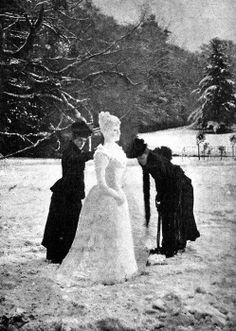
Wish I knew more about this striking image I found online


Kind of a new twist on "Stopping by Woods on a Snowy Evening."

You can still purchase these dolls on ebay or maybe find some buried in your backyard. One more fun element about the dolls; some of them have unglazed backs so that they can float in the bathtub. Apparently people sometimes baked the smaller ones into cakes. Yum, tasty corpse in my red velvet slice! And, true to Victorian sensibilities, some came with their own coffin.


. . . .


Monday, November 14, 2016

When the scales (of justice) tell a heavy tale

Abby Borden, Lizzie's stepmother, was 64 at the time of her murder. She was 5'3" and weighed 180. The autopsy record describes her as "very well nourished and very fleshy." It seems like adding insult to injury to chastise her for her weight, but that is what some chroniclers have done.   

Abby Durfee Borden


Despite this, I enjoyed one of the iconic nonfiction books about the Lizzie Borden case, Victoria Lincoln's A Private Disgrace, which won an Edgar award in 1967. The author was born in Fall River, Massachusetts, in 1904, twelve years after the murders took place in 1892. She knew the elderly Lizzie Borden as a several-streets-over neighbor but admits she had initially remembered her as living right next door.

The fan is a hatchet: clever book design


The book is confusing at times, with vague pronoun usage and a somewhat meandering through-line, but two things mark it as special:

1. Thanks to her banker grandfather, Lincoln has a piece of insider information that she feels explains the murders: Andrew Borden (Lizzie's father) was planning to transfer a beloved bit of seaside property to Lizzie's stepmother Abby, and Lizzie found out. It helps to know that an earlier and similar deed transfer of a house on Ferry Street took place to assist Abby's impoverished sister. Lizzie and her sister Emma were enraged for some reason, and at that point Lizzie ceased calling Abby "mother" as she had done since she was a toddler and her widowed father remarried. Lincoln thinks Lizzie got wind of the idea (literally on the wind: she believes Lizzie in her second story bedroom heard murmurings from the open windows of the sitting room below) and resolved she would prevent its happening. Lincoln thinks Lizzie only meant to kill Abby, but Andrew came home too early for her to figure out what to do with Abby's body.

2. Lincoln thinks Lizzie did the killings in an epileptic fugue state.

It's well worth a read, but what befouls the book for me is Lincoln's disparaging remarks about Abby's weight.

Another cover I saw online: interesting claw hand


The poor woman took 19 blows directly to her head and neck (not the 40 whacks of the jump-rope rhyme, but still a wretched volume that implies great rage on the part of the perpetrator)...and she's still getting hit. Lincoln cannot seem to describe Abby's walking as anything other than "waddling." Throughout the book, she scorns Abby's weight. Here are a few passages:

"The day is hot; the calico is damp and crumpled with the sweat of her 80 excess pounds of fat, and her pale face shines with it."

"At the inquest, Lizzie claimed that Abby waddled almost daily to market." (Lincoln argues that Abby was basically housebound, and Emma or Bridget did the marketing).

"She only wanted peace and quiet in which to eat her way on through her living death."

Not considering it enough to cast aspersions on her weight, Lincoln attacks her cleanliness too:

"Abby, enclosed in fat and self pity, was the kind who make indifferent housekeepers in any part of the world."

Lincoln even blames Andrew's murder on Abby's weight!

"The problem was, in essence, Abby's fat; if she had weighed 30 or 40 pounds less, Andrew Borden might well have died in his bed."

I read once that making fun of fat people is the last standing societally-acceptable cruelty. The Polack jokes from my childhood have vanished, but not acceptance of the lyrics from a polka I remember from then: "you can have her, I don't want her, she's too fat for me."

Another clever design: Lizzie is the murder weapon


Abby's post-mortem indignities continued: the contents of her stomach were compared to her husband's, a slim and reedy man.

Moreover, and sadly, the crime scene photos can be easily seen online. I won't link to them here, but you can google them. Andrew, thin, reclines on his lounge, his head destroyed, while Abby lies face down on the floor, a large woman felled by her assassin. I have spent a lot of time studying the pitiful sight of her upturned shoe soles with their humbled nails. I can only hope she rests in peace. 

Abby Durfee Borden


After a handful of Lizzie Borden posts (and many more to come!), I'm happy to announce there's a reason behind them. My novel The Murderer's Maid has been picked up by Yellow Pear Press and will launch in October 2017. There is a big coincidence with the press's name: pears feature prominently in the Lizzie Borden lore—she claimed to be eating pears in a hot barn loft while one of the murders was taking place in the house. It's kismet that the press's name and the novel match up.

I'll update here as news progresses, including a cover reveal in a few months.


. . .

Sunday, October 16, 2016

Did Lizzie Borden try to poison her father and stepmother?


If a woman was accused of murdering her father and stepmother, both of whom were brutalized with a hatchet, and you knew she had been trying to buy poison the day before, wouldn't you consider that important evidence?

The judges in the Lizzie Borden case didn't.


Eli Bence, upright and concerned gentleman druggist, from findagrave.com


When Eli Bence, a druggist, tried to testify on the ninth day of the trial that Lizzie had come in and tried to buy prussic acid from him, the defense attorney objected. The jury was temporarily taken out, as was Bence. 

Prussic acid, by the way, is hydrogen cyanide. It was used as an ingredient in Zyklon B.

In the 1800s poison bottles were sometimes in the shape of skulls,
so even if blindly clutching a bottle in your candlelit pantry,
you would know it was dangerous. From wired.com

In a conference at the bench, prosecution attorney William H. Moody (who would later serve as U.S. Attorney General) told the judges what Bence was preparing to say: Lizzie had tried to buy prussic acid, saying it was for cleaning her sealskin cape, and he had refused to sell it to her since she didn't have a prescription. Lizzie had lightly argued, saying she had bought it there several times before.

Lizzie's attorney George Robinson (former governor of Massachusetts) objected, saying since there had been no sale, the testimony didn't matter. Hosea Knowlton, the other prosecuting attorney, stated that he had evidence she had tried to buy prussic acid in another place, also unsuccessfully. 

Robinson countered that since no poison had been found in the stomach of Andrew and Abby Borden, "There is shown no connection, as assailing the lives of these two persons....it is an attempt to charge her with an act causing death by a wholly different means, for which, of course, she is not now on trial."

Robinson went on to say that since the prussic acid attempt was on Aug. 3 (1892), and the murders were on the 4th, "the nearness of time may be considered out of this consideration; it is not sufficiently near, if it were pertinent."

Lizzie Borden, sometime after her acquittal.


Call me crazy, but the day before is pretty darn near. I guess, however, if the only way you can even begin to wrap your mind around a woman committing such a crime (please see my previous post about Lizzie not facing a jury of her peers) is if you consider it a crime of passion, then the previous day doesn't work. Because that reconstitutes the crime as one of premediation (although...if Abby was murdered at least an hour before Andrew— and she was— that also takes "crime of passion" off the table).

Robinson continued on to say  that even if Lizzie did try to buy the prussic acid, it was "an article which a person may legitimately buy." He closed with, "Does it have any tendency at all to show that this defendant killed these two persons with an ax? That is all we are inquiring about. I maintain it does not."

Moody rightfully jumped in to claim premeditation. He raised the issue that the Bordens were ill days before the murders. He said that the day before the murders*, Mrs. Borden had gone to the neighbor, Dr. Bowen, "and stated that she had been poisoned the night before." Not food poisoned: poisoned.

*Records suggest her visit to Dr. Bowen was in fact on Aug. 2 rather than the 3rd.

A late 1800s drugstore (in New Zealand). Not exactly Fall River, but we can still picture
Lizzie Borden stepping up to the counter.


Moody discusses the concept of relevance, referring to "Mr. Wharton's treatise upon Evidence." (Another blog post for another day: the Shakespeare-spouting prosecution as too erudite and professorial for the farmer jury who resented city folk. Victoria Lincoln's book A Private Disgrace contains a great rumination on this).

He then threw down precedents from Massachusetts and other states. One interesting one was from Pennsylvania, where a man had stated earlier in the day that he wanted to kill someone before the day was out, and then he was charged for the homicide of someone killed that day. Moody went on for a long time talking about other cases. (Another blog post for another day: the sheer boredom endured by the jury. The transcripts even show the attorneys talking about how they had to break for the day because no one was listening).

Robinson's last hurrah: Lizzie herself was sick; why would she poison herself? Moreover, she hadn't stated she was buying the prussic acid to kill anyone: "My friend [Moody] said in his admission that there is nothing in this evidence to show against whom she premeditated the malice." He made a strange hypothetical comparison, supposing that Lizzie had bought the poison to kill Bridget Sullivan, the maid.

Moody: "There is a tendency to show to whom the malice is directed."
Robinson: "Is that what you said?"
Moody: "That is what I said."
Robinson: "...where is it? where is the least tendency? Where a scrap, even? Well, people buy prussic acid to kill animals--it may be the cat...."

Take your choice: prussic acid or hatchet, shall we say?


More legal bickering ensued, then the justices withdrew for consultation. They thought the evidence was competent, and they would hear preliminary evidence before deciding whether Bence could testify.

The next day, preliminary evidence was heard from a pharmacist, furrier and chemist, all talking about if prussic acid could be used for the purpose stated by the mysterious shopper in Bence's drugstore (short answer: no, although my edited version of the trial transcript doesn't contain their testimony).

That was followed by a half-hour confab between justices and counsel at the bench, "all speaking in low tones and out of the hearing of the stenographer" (Pearson 252).


Eli Bence


What was said in that conference? We'll never know (but keep reading, there's a theory below). The upshot: the poison evidence was excluded, and Bence was not allowed to testify.

So here are some of my thoughts.

I think Lizzie tried some kind of homemade poison first. Everyone sickened, but no one died. So she tried to buy real poison, asking for prussic acid as a cleaning agent to disguise its real purpose, but no one would sell it to her. In frustration, she turned to the hatchet.

My response to Robinson would've been, yes, the two methods (poison and ax) are very different, but doesn't it seem like the more "genteel, woman-acceptable" form of murder would be first selected by Miss Borden?

Circling back to what was generally accepted to be food poisoning within the Borden household, a few things are important to note:

  • Everyone was sick, including the maid Bridget Sullivan and Lizzie herself. Lizzie could've claimed to be sick, going into the basement water closet and making the right sounds if anyone was listening, but poor Bridget went out into the yard to vomit. If we accept the idea that Lizzie tried to buy prussic acid:
a)      she had to poison Bridget to cover her tracks, or
b)      she didn't expect Bridget to eat the dish she'd poisoned, or
c)      Bridget only claimed to vomit, which would mean she was in on the plot.

  • They might've really had food poisoning as a strange coincidence with Lizzie's attempts to buy poison. Much was made of the sad fact that the family had been eating, in varying incarnations, the same roast of mutton for a week. Although they had an icebox with a melting chunk of ice instead to chill the leftover meat, the first week of August 1892 was unseasonably hot. In fact, I watched a play about ten years ago in San Francisco, the main thesis of which was that the heat drove Lizzie to her nefarious deeds. On the morning of Aug. 4, breakfast included, among the more-expected johnnycakes, warmed over mutton stew. One could insert a poor-taste joke that perhaps the elder Bordens did themselves in after that repast.


    Bence's low-key tombstone, from findagrave.com


I had long considered Lizzie's attempts to buy poison one of the two most compelling indications of her guilt, the other being her burning of a dress shortly after being informed she was a suspect.

Yet my tour of the Lizzie Borden house, led by incredibly well-informed guide Colleen Johnson, introduced a bit of explanation I had never heard before. She said that the conference at the bench was about a secret police sting whereby police officers' wives would enter drugstores and try to procure poisons without a prescription. The sting was ongoing, hence the need for secrecy. Moreover, one officer's wife resembled Lizzie Borden. It was a case of mistaken identity. 

I'd love to have the existence of the sting solidly confirmed. A few questions arise:

  • Do police files still exist to confirm the planning and implementation of such an operation?
  • Was there an upsurge in arrests for druggists during this period? Perhaps newspaper police blotters could bear this out.
  • Would such a sting, in operation in August 1892 when Lizzie was reportedly trying to buy poison, still be either happening a year later during her trial, or still so fresh it couldn't be released to the public?

In favor of this theory is the oddity of the judges so readily dismissing Bence as a witness. It would explain the very lame explanation that was given for suppressing the evidence. It would also instantly explain away Knowlton's stated knowledge of other attempts at other drugstores.

Tour guide Colleen Johnson has been incredibly helpful, answering questions for me via email after all the millions of questions I asked her in person. She sent me the following quotation in response to my questions about the sting:

According to an article in the Fall River Evening News, published on August
15th,  1892
 
..."The poison theory, so far as actual use of the drugs by the victims is
concerned, has been practically given up.  The importance now attached to
the alleged effort of Miss Borden to purchase prussic acid is based upon
the theory that she intended to use it herself, should she be suspected of
the crime.  This, however, is not very tenable, as Miss Borden had ample
opportunity to do away with herself since these suspicions were made known
to her by other means.   The fact that Inspector McCaffrey has several
female agents in Fall River at the time of the murders, also  leads many to
believe that the identification of Miss Borden as a person who sought to
buy prussic acid is a case of mistaken identity"
 
The above quote is taken from a book called Lizzie Didn't Do It, by William
Masterton, page 176.

Interesting that there was a thought Lizzie bought poison as a suicide measure if she was imprisoned (the punishment, had she not been acquitted, was death by hanging, so possibly preferable?). Then there is that mention of "female agents," which tends to support the idea of the sting.

This case has so many twists and turns it is no surprise it is so studied and talked of today.

In other news, in honor of October's witchy gloom, my novel The Witch's Trinity is on ebook sale until Oct. 24 at only $1.99. When medieval German woman Gude is accused of witchcraft by her own daughter-in-law, she must examine herself to see if the finger pointing is true.
"In searingly simple prose, Mailman probes the human psyche, peeling back the layers of the basest human instincts to expose the dangerous frailties of the human soul." —Booklist
“A disturbingly effective historical novel.” —Boston Globe


Note: All trial quotations in this post are from Trial of Lizzie Borden by Edmund Pearson, 1937 (1989 Notable Trials reprint).


. . .

Saturday, September 17, 2016

Lizzie Borden and a jury of her NOT peers


In 1892, when Lizzie Borden was accused of murdering her father and stepmother with a hatchet, women were not allowed to vote. They were not allowed to serve on juries. Lizzie therefore didn’t face a jury of her peers; she faced 12 men who didn’t believe her physically or even foundationally capable of such a brutal murder.

Questioning at the inquest and trial looks at the height of her father, Andrew Borden. Could she, a woman, have been capable of felling such a tall man with such an instrument? Well, it helped her cause that he was reclining at the time, lying down asleep or close to it, on a lounge in the sitting room. Andrew was also very frail and thin. When I first looked at the autopsy photos of him shirtless, lying on a wicker autopsy table, I thought he was a woman. His thin chest even curves in to a bit of an hourglass waist.

And could Lizzie possibly have been capable of bringing down her very stout stepmother? Abby was 180 pounds, and short. Victoria Lincoln’s nonfiction book A Private Disgrace never talks of Abby walking without it being described as “waddling.” Her fat is relentlessly mentioned with deep scorn by Lincoln. Lizzie herself was quite solidly built and tall—but could she bring down someone likely more physically powerful than herself?

The first blow was established to be one on Abby’s forehead. She must’ve faced her killer, who raised the weapon and blatantly struck her while being watched. Now if her killer was her own stepdaughter, whom she had raised since the age of three, Abby must’ve calmly faced her hatchet-holding child, perhaps even amused to find her upstairs in the guest room with such an odd item in her hand. The wonderful Elizabeth Montgomery movie, Legend of Lizzie Borden, even portrays Abby as looking up at Lizzie from making the guest bed with a smile. Which quickly turns to a frown and then…well, you’ll have to watch the movie.

Subsequent blows were to the back of Abby’s head and neck. It is surmised that the killer straddled the now-face-down Abby and rained down the blows. It is fascinating that both deaths only involve blows to the head. Did Lizzie, or whoever the killer was (see how I did that?), read that there is not much blood flow to the outside of the head—I mean, certainly the brain gets blood, but the thin layer of skin covering our skulls doesn’t contain many blood vessels? Was the killer deliberately trying to attack a place on the body that wouldn’t create a huge flow of blood to be cleaned off, say, one’s clothes?


Getting back to the idea of that all-male jury in Fall River, Massachusetts. The name of Sarah Jane Robinson was evoked by the prosecution as an example of a woman quite capable of murder, thank you very much. Between 1881 and 1885 (the Borden murders were in 1892), and in nearby Cambridge, Massachusetts, Robinson murdered eight people. The difference to this jury, however, was that she did it in a womanly way: she used arsenic.

Moreover, Robinson was born in Northern Ireland, part of a a class of people despised at this time period (in fact, when Lizzie dispatched her Irish maid to find a doctor for her father’s corpse, she only asked for Dr. Bowen, kitty-corner to their house, and when he was not at home, she completely ignored Dr. Chagnon, kitty-corner to the back because he was French, and the next-door Dr. Kelly….because he was Irish. She instead asked for her friend Alice Russell).

Although the Robinson case first resulted in a hung jury because jurors were only permitted to know about one of the many proven arsenic deaths (bodies were exhumed and tested), a second trial allowed the admission of these other murders, and Robinson was sentenced to hang. A petition (signed by seven jurors!) asked that the sentence be commuted to life in prison and so she was, with the addition of solitary confinement. She died in prison in 1906.

I’m certain that had Lizzie Borden been found guilty, she too would not have hung. Public sentiment would’ve rallied deeply in her favor.

My point is that the Irish Mrs. Robinson, of a “dirty” immigrant class, who had used the effortlessly-delivered-in-food arsenic for her plots, was easier for a jury to find guilty than Massachusetts-born Lizzie Borden, whose father owned banks, who was very active in the church, who volunteered for the Woman’s Christian Temperance Union and the Fruit & Flower Society, who was accused of something so masculine as wielding a hatchet directly into family members’ brains.

Let’s take a moment just to consider such an act. Although perhaps farm women hefted axes to make firewood, to sever chickens from their heads, the genteel Lizzie Borden would not have done so. In fact, not even Andrew Borden did this work. A hired man came. In short, a hatchet was not a tool a woman was seen as using, so a hatchet as a weapon was an even farther stretch.

The Fall River Historical Society has a new artifact as of this summer: a letter Lizzie wrote to one of the jurors, thanking him for acquitting him. A thank you note: what a nice, ladylike thing to do!

. . . . .


Saturday, August 13, 2016

Confessions of a serial plant killer


Call me Lizzie Borden of the Lobelias.

I love plants and flowers and never intend to do them harm, but alas have some penchant for spelling their demises. Cacti, which apparently are very difficult to murder, have lapsed and sagged under my attentions. Ficus have browned. Spider plants have woven their own webby cauls and collapsed. However!

I have had good luck recently. I have not one but TWO success tales underway.

Tale the First. This narrative involves an orchid that was (!!!) $5.99 at my grocery store, and I figured even if it died within days, it would be the same as purchasing a low-cost bouquet. But I brought it home thinking, "If only I could keep it alive..." I googled how, and learned that the orchid requires, get this, "benign neglect." That is so up my alley! I calendared two week increments to soak it in boiled-then-cooled water, then ignore it. I faced it by the eastern window as the internet directed.

It has thrived. It actually opened up two blooms. I was incredulous. It has also lost two of its existing blooms, but I am given to understand that may be natural? At any rate, the losses have equaled out the gains and I feel pretty proud of my orchidal accomplishment.


Tale the Second. The same grocery store was offering bulbs in boxes for 25 cents. I figured at these bargain basement prices, the bulbs were already dead, but what the heck. So I planted the dinner plate dahlia in a cracked white cereal bowl and watered it casually when I was in the kitchen and thinking about it. In disbelief, I have watched a green shoot emerge from the brown woody stem, and get bigger each day. I did that. Me.

I'm scared to transfer it outside, especially given our 100-plus temps this summer, but eventually I will usher my fledgling to the real dirt outside. Wouldn't it be wild if it worked, and I actually grew those blooms that are the size of dinner plates? I would faint.


. . . .

Contentious attorneys in Lizzie Borden case

Reading through trial transcripts in the Lizzie Borden case (1892) can be mildly entertaining in terms of the touchy interactions between defense and prosecution attorneys. They were trying to get to the bottom of a horrible and upsetting crime, yes--the murder of an older man and his wife--but that didn't stop them from getting frustrated with each other.

Not only that, their formal language was sometimes so obfuscated that witnesses pled confusion. Here's an interaction I was re-reading yesterday that made me laugh out loud. This follows a long and complex description of the individual hatchet wounds: where they were placed by the assailant on the victims' heads, and their measurements:


I laughed at Mr. Knowlton's spunky, "I submit whether the questioner himself understands the question." Hosea Knowlton was attorney for the prosecution, trying to get the jury to find Lizzie guilty (they didn't).

Adams rather defensively replies, "I do. I understood one of yours a little while ago, that you had trouble about understanding yourself." Adams then returns to the witness, asking, "Well, do you understand the question now?" although no explanation had been offered, and the witness meekly asked, "If I may be permitted to state what I think the question is?"

It's Laurel and Hardy, practically. Who's on first? What's the question?

A few lines later, Adams inadvertently insults the witness, Dr. Dolan, by referring to his "attempt at an autopsy," which phrasing Dolan calls attention to.

At any rate, a bit about the book. It's a lovely bound version of Edmund Pearson's Trial of Lizzie Borden, with incredible paisley end papers, gilt page edges, and that wonderful red ribbon you see above (blocking the rest of the testimony) which provides a built-in bookmark. It's a treasure of a book and there's a bit of a story behind it that I'll blog about later.


. . . .

Thursday, August 04, 2016

Anniversary of Lizzie Borden double murders

Today, August 4, 1892, in Fall River, Massachusetts, a middle-aged woman named Lizzie Borden called out to her maid to come downstairs. The cause of the alarm? Her father had been killed. Bridget Sullivan came down and thus proceeded the strangest of mornings, with contradictory tales told of what Lizzie had been doing at the time her father bore the brunt of multiple hatchet marks to his head and face.

With the alarm raised and neighbors and a kindly doctor surrounding her, Lizzie then reacted to the question where her stepmother might be during all this commotion. "I thought I hear her come in," she said vaguely, asking Bridget to go upstairs to check. Bridget quite rightly refused to go alone, and neighbor Mrs. Churchill climbed the stairs with her. Towards the top of the stairs, as they turned their heads, they could see under the bed in the guest room where Mrs. Borden lay on the other side, also hatcheted to death.

Lizzie Borden was acquitted, but history has wondered for over a century if those jurors did right.

In the 1970s, a made-for-TV movie starring Bewitched's Elizabeth Montgomery did a very decent job of telling the tale. It's called The Legend of Lizzie Borden. The movie set features a floorplan replicating exactly the Borden household (for those who follow this story, the floorplans play an important role in untangling the who-was-where-when stuff, replete with locked doors and doors blocked by desks). Elizabeth portrays Lizzie quite well, despite being younger and more attractive. They shared an ancestor in common, it turns out.

Elizabeth Montgomery as Lizzie Borden

Lizzie Borden
The movie is worth watching. It's out of commission, but I found a DVD through my library. One of the scenes I found the most interesting I will link to here. When Lizzie's lawyer tells her she faces the possibility of death by hanging for the crime she's suspected of, she reacts with such horror that it literally made my heart leap.

And of course, what is most telling about that moment is that at no other time does Lizzie show horror in the film. Not when she sees her father's body--disinterestedly lifting up the sheet in the middle of the night where his body rests in the dining room, awaiting its autopsy, a brilliant choice on the part of the filmmakers, for those bodies did indeed rest in the house with living occupants... Not when she discovers it, not when she worries (as one would) that the murderer may yet lurk in the house. Mr. Borden's head was so destroyed that his eyeball was cut in half, and yet the only moment Lizzie shows horror is when her own fate is endangered.

Was that Hollywood license? No. The court testimony has repeated witnesses testifying to Lizzie's remote character within moments after the murders. "She was cool," said a police officer. Lizzie never cried, never screamed, never showed distress. To me, most importantly is that she never showed fear. If some intruder came into the house and murdered her father and stepmother, why was she not running into the street in terror that she might be the next victim?

One answer: she knew there was no intruder.

Here's that clip. It's ten minutes, and the moment of her realizing she may hang for the crimes comes around 4:00.


The credit for it: "Lizzie Borden - No Longer Believed" AwesomeStories.com. Oct 07, 2013. Aug 04, 2016. .


Monday, August 01, 2016

Doing what we can...


Two pleas today, and both cancer-related. Yeah, the C word, the thing that makes us enraged because we're helpless and don't know how to fight it.

Well, here's two meaningful ways to help.

Anyone who's read my blog over the years knows about Jennifer L. Kranz, the sweet, cute six year old who died of DIPG a mere 3.5 months after diagnosis. Her parents created the groundswell Fluttering movement, in which people purchase a Fluttering kit of lawn-ornament dragonflies and commit to moving the dragonflies yard to yard throughout September, with official Unravel paperwork that requests a donation to the nonprofit foundation in return for selecting where the dragonflies go next. Today there is a flash sale of the Fluttering kits. Fluttering is a good thing to do with your own kids--talk to them about how to use our bodies to help others, that the daily task of moving the dragonflies is raising money to help researchers figure out kids' cancer. You can Flutter in the name of someone you know who is fighting now or in memory of someone. It's a meaningful, intense, beautiful thing to do. Purchase your Fluttering kit here.

And here's a silly video from Jennifer's mom explaining the "flash" part of the sale.


The other way to help: my friend Nanea Hoffman is the founder of the popular and wildly-clever blog Sweatpants & Coffee. She was recently diagnosed with breast cancer. She has created the "Anxiety Blob" to squeeze at moments when the world seems too much. These blobs are for sale now here. Also, subscribe to the blog and follow her caffeinated story!

. . . . 

Tuesday, July 19, 2016

An engaging look at the past

Mary Volmer's Reliance, Illinois, is a book I've been enjoying in slow sips, like a glass of very old sherry. It rewards slow reading, for Mary's prose is unlike any other writer's. I first got to know Mary through her novel Crown of Dust, which for a Gold Rush novel is unusually dark, somber, laden with ochre. This isn't the ebullient "Westward, ho!" novel...it's about the people who didn't strike it rich and got stuck in a part of the west not well traveled. Its quiet beauty is memorable. But I digress...I'm talking about Reliance now!

Again set in the 1800s, Reliance is about a small town and its secrets, and one girl at the center of it all. Look at this gorgeous cover.


I asked Mary to do an interview on my blog and she agreed to answer these three questions. Mary's doing a reading at Face in a Book bookstore in El Dorado Hills, California, this Friday the 22nd at 6:30 p.m. I'll be there, and I hope I'll see you there too! Mary's a great presenter, and it's sure to be a fun and witty night!


1       1. Why are you so drawn to the 1800s?
Mom always had biographies and historical novels lying around the house.  When I was a girl, she read me books such as Johnny Tremain (a revolutionary war novel), and 19th and early 20th century authors like Laura Ingalls Wilder and Louisa May Alcott. I suppose it’s no surprise my imagination turned to the past when I started making up my own stories. I guess another reason is that when I started writing seriously I was living abroad in Wales, a country with a rich history, physically apparent in the castle ruins and standing stones that graced the landscape of my university town, Aberystwyth. Living there, I felt oddly compelled to look back on the history of my own town and country, and also to question the national narratives, those simplified (often sanitized) origin stories, I learned in school. I discovered the relatively short history of the United States was full of vibrant and volatile landscapes, contradictory accounts and fabulous characters. It seemed natural to write about them. And the disconcerting fact of the matter is, we’re dealing today with many of the same issues and fears that consumed us generations ago. 

2. Your characters are often downtrodden, powerless. Can you address that?
I’m drawn to survivor stories and tales of resilience, and I’m equally drawn to stories about women, who in the 19th century were largely downtrodden. Until the latter half of the century, women possessed few economic or political freedoms and had little access to education. While they were not universally powerless, any authority they wielded had social consequences far more serious than the many layered stigmas powerful women endure today. I’m fascinated by the lives of these women and the communities they loved and struggled within. If history is written by the victors, I think an argument can be made that fiction (a great deal of it, at any rate) is written for the downtrodden, the forgotten, the novel and unnamed.    

3. What are you working on now?
I’ve been working on three projects, but will need to settle into one of them in the next month or two (or none will get finished!). The first is a contemporary novel set in the Sierra Nevada Foothills, the second is a detective novel set in two time periods: contemporary and colonial Virginia. The third is set in Boston, Northern England and South America after WWI. That’s a vague answer, I know, but I don’t want to give too much away! And, of course, the stories will change as I write them. 


. . . .  

Wednesday, July 13, 2016

Beautiful Montpelier

I grew up in the capitol of Vermont, and it is the most beautiful place in the world. I hadn't been back in literally decades before we went two years ago, and this year we returned to see the lovely Fourth of July bunting.


This is the City Hall, which used to contain the police department, but I noted that has moved to a standalone building in its back parking lot.


This is the fire station.


This is a magnificent indie bookstore. There are actually two downtown--amazing for a city with a population of less than 8,000!


And this is a sign in a storefront that cracked me up. Yes: this is Montpelier. Thanks for being a great place to grow up!


. . . .


Monday, June 06, 2016

Summerwords Creative Writing Festival 2016

I think this festival gets more fun each year. Our keynote speaker was Luis Alberto Urrea, who simply couldn't be a funnier, more witty, more poignant speaker and reader. I heard many "lightbulb ah" gasps from the crowd when his short story (which he had memorized and delivered as a performance) concluded.

I presented on writing series fiction and had a full room with lots of great energy and laughter--love it when group dynamics make this kind of thing an outright pleasure. Thank you all who attended my session!

A brief writing activity in my session on writing series fiction.


I also attended many presentations myself and of course the magnificent barbecue that crowns Saturday night at the festival. People may be amazed to realize that their ticket, very reasonably priced for a four-day conference, also includes a stellar barbecue with free-flowing beer and wine. Just saying, mark it on your calendar for 2017!

We've had amazing keynote speakers in the past: Carolyn Forche, T.C. Boyle and now Urrea (I've only attended the last three years), but the conference really revolves around the daily sessions, usually four to pick from each hour. American River College faculty teach these, as well as visiting writers. It's the kind of literary event you would imagine a major university pulling off, but American River College is a small community college in Sacramento with a passionate creative writing faculty that designs and implements this large-scale conference. ARC's literary magazine also consistently wins national awards, beating out schools like Harvard...

The video for this year's Summerwords somehow features me as the freezeframe, which I found preposterous and fun:


I wish I'd done more pre-Summerwords social media but a) we sold out anyway and b) I was in the throes of a move...yes, we moved house two days after the conference which took place May 26-29 . That was...let's see...less than a week ago. I'm still looking at boxes as I type this. May I mention for purposes of eliciting deep sympathy that it was 100 degrees the day of our move?

Next I'll have to blog about the wonderful Gold Rush Writers Conference. In the meantime, a writer friend is part of Barnes and Noble's new Teen Book event, B-Fest. Lynn Carthage (winkety wink) will be appearing at the Natomas B&N in support of Betrayed and Haunted this Friday, June 10, at 7 p.m.


Thursday, April 21, 2016

That time I had to go write in a field


I'm so pleased with this article in the Sacramento News & Reviews, written by Rachel Leibrock and photographed by Darin Bradford. I think Rachel did a great job of encapsulating my work thus far and highlighting my love of strong women protagonists.

Darin's photo was very fun...I'm actually just in an overgrown vacant lot with my desk that I threw in the back of my car. There's a chain link fence and a freeway ramp behind me, but he did some magic to make it look like the ideal writer's spot. I've always fantasized about a bed in a field (I think based on some perfume ad from the 1980s!) so this was pretty darn close. It's subtle, but there are also some tombstones in the field there with me. Fitting!

The link to the article is here.


. . . .

Saturday, March 19, 2016

5th annual Chin Up for Writers Day

Yes, March 19 is upon us again...after the Ides and after the Irishness...it's Chin Up for Writers Day!

Because we writers are a special breed of self-doubting and turmoiled creatures, we need a day on which we examine our chins, winch them up and attempt to keep them up. Because our nature is to explore the very essence of why we're human, we become sensitive when our soul-baring (what is writing if not taking off your brain's clothes?) doesn't bring the attention, acclaim or financial rewards it might. We are turning on tiny lights in far-off forests and sometimes no one sees but the tin-foil fox. I think I ripped off Mandelstam in that sentence.

I had another book in the Y.A. series release and tomorrow is the big launch party at a wonderful independent bookstore.
C'est mon roman.

My chin should be firmly horizontal. It is. I've worked hard for this day and I think the book is pretty kick-ass and fun and should make any visit to Paris or Versailles way more interesting (mental note: get Versailles gift shop to carry it). And yet... the chin drifts. It drifts because I'm introspective and writerly and while I usually get along well in the world (and I think I even successfully carry off an attitude of general optimism and glass-half-fullism), there are days where I belong in a garrett cursing the few stars I can see from its window.

Let me make a quick phone call to the plastic surgeon about this drifting chin issue.

Back! They were of no help.


I've found the best tactic is to move forward. I recently reached up above my desk to check off a major project on my to-do list taped to the wall, and I'm happy that now I can hit the next project. Chin up, head down, always moving.

Until next year, fellow writers! I will know you by the proudly erect jawlines.

If you'd like to read the previous years' posts on Keep Your Chin Up Day:
First year
Second year
Third year
Fourth year


. . . . . 

Sunday, February 28, 2016

Little Unperturbed Women


I've spent the last 20 minutes with my heart in my throat. My daughter has been reading an adaptation of Little Women and as we departed, she told me that Beth had been holding the Hummel baby as it died of scarlet fever, and that now Beth was showing signs of the sickness.

I sat and fretted. When I heard her come down the hallway, I turned to her with open arms. But she wasn't crying. She was grinning. "I finished the whole book!"

"And...Beth?" I asked shakily.

"Beth got better!"

"Beth got better?!"

"Yeah!"

I gave her a hug and passed a tremulous hand over her hair. It has been averted for now. But someday I want her to read the real book.


. . . .

Wednesday, February 17, 2016

Witch boy

Child witch of Nigeria, starving and pushed out of his home. Image: Anja Ringgren Lovén


With a heavy heart, I see child witches are in the news again. It was wretched when the vulnerable elderly or mentally ill were accused in medieval times, but there is a particular evil associated with accusing children of witchcraft.

(They were accused in the medieval period as well, but not to the degree that we find today in African nations.)

How my heart mourns for these children who need protection. Thank goodness the world has responded to these photographs and donated the equivalent of $150,000, thanks to the efforts of Danish aid worker Anja Ringgren Lovén.

Read the news report here.


. . . .

Monday, January 11, 2016

Ashes to Ashes, Funk to Funky

from radio.com

My husband told me this morning at the breakfast table.

"Something happened today that's going to upset you."

"Something in world news?"

"Yes. And it will affect you personally. Should I tell you?"

"I don't know." I was thinking about getting the kids off to school and I didn't want to sink into a whirlpool of grief until they were dressed and out the door.

"It's going to ruin your day," he said. "But you'll hear about it other ways."

"Okay," I said. "Tell me."

"David Bowie died."

I let loose with an expletive and immediately hid my face. Crash, crash. No. Not him.

He had cancer for 18 months, my husband told me, and somehow the world didn't know as he put together Lazarus. Interesting name, that. I went to Facebook briefly and saw that I had posted a lot about Bowie recently (was someone releasing a lot to bolster his sense of his impact on the world before he left...I had interpreted it as just publicity around Blackstar), and with one revolving gif that showed all his different identities, I had titled it "Always and forever." As I knew somehow.

I'm forever grateful to Amy Carpenter for introducing me to David Bowie with a mixed tape back in the '80s. He was then popular for Let's Dance, but she gave me the wierder 1970s stuff that opened strange doors that I'd never close again. I loved David Bowie's music, his mutability, his creativity, his vocal idiosyncrasies. His work was filled with emotion and I responded to that.


I'm also forever grateful to my college boyfriend who orchestrated our going to a Bowie concert in Stuttgart, Germany. We were there visiting his brother in Ansbach (we were both on junior year abroad), and we heard on the radio that Bowie was playing in Stuttgart, not too far away. We had Interrail passes which gave us unlimited travel on the railway systems of Europe since we were considered temporary European residents for attending college for a year there, so we said goodbye to his brother and sister-in-law and hopped a train for Stuttgart. We headed for the concert hall there, bought scalped tickets outside, and proceeded in.

It was an amazing show. It was BEYOND AMAZING. It was the Sound + Vision tour, and I'm forever grateful that if I only got to see Bowie perform live one time, it was when he was playing the songs of the '70s that I loved. Sound + Vision was almost like a "greatest hits" tour. And I personally love the song Sound and Vision and what it says about the creative process. He was one of the first to play with video footage and there was a giant three-story David Bowie that accompanied the real man on the stage, interacting with him in clever and sometimes mindblowing ways, bending down to talk with him and the like. It was extraordinary and so freaking cool.

We spend so much on the scalped tickets that we didn't have enough money for a place to stay afterwards (and I think we didn't return to Ansbach because it would be so late at night and we didn't want to wake them--they had a small daughter too. Man, that girl is probably in her early thirties now...whoa...). So, instead we rode the trains for the rest of the night, picking a destination at the end of the line, trying to sleep as best we could, then deboarding and randomly picking the next train going the furthest away, all with that tired exhilaration that comes from watching a great concert, strains of music still in your ears.

We were doing just what he said, "driving like demons from station to station."

I'm sad to have to say goodbye to a musical hero that has filled (and will continue to fill) my life with so much pleasure and ...well, feelings. You can't just have his music on as a background; it's impossible not to dance to it or sing along and wish that you could tell him personally how much his words and music meant to you. I now have to erase one fantasy off my list, the backyard BBQ where we sing Under Pressure together. I guess that means I need to get moving on my other fantasies.

Ain't there one damn song that can make me break down and cry?
Yes, David: all of yours.

My sympathies to his wife and family.


. . . . .