Showing posts with label Abby Durfee Borden. Show all posts

Saturday, August 03, 2019

Bridget on the stairs: a post for the Lizzie Borden anniversary


This post is for the anniversary of the murders of Andrew and Abby Borden, husband and wife, killed August 4, 1892. Andrew's daughter Lizzie was accused and underwent a trial that was in all the newspapers of the day, a huge national spectacle that ended in her acquittal.

I had long been fascinated by this case and the idea that Lizzie might've "gotten away with murder," for surely she was convicted by the jury of the Public, if not by the jury of her peers (well, actually, the jurymen were not her peers; I blogged about that here).

The more I learned about the case, the more my interest circled around one individual whose role was consistently downplayed: the Irish maid Bridget Sullivan. Bridget had been in the employ of the Borden family for several years, had tried to quit a few times, and was the only person in the house that fateful day besides Lizzie and the victims.

Why was Bridget's role not larger in the trial? Because of her immigrant status. In the cartoon above, originally from Harper's Weekly and found in the book Out of Ireland: The Story of Irish Immigration to America, you can see how the Irish were deplored as they arrived in the 1800s, often hungry and poor.

This cartoon ran April 28, 1883, almost a decade before the Borden murders, but is a good example of how Americans viewed the arrival of the Irish. The cartoon's title reads, "The balance of trade with Great Britain Seems to Be Still Against Us" and its text says, "650 paupers arrived at Boston in the steamship Nestoria, April 15th, from Galway, Ireland, shipped by the British Government." The sails on the dinghy rowing out to meet the ship say, "From New York, the DYNAMITE," which I initially thought to be the wish to blast the immigrants into oblivion, but has a more complex meaning, referring to Irish-American activists who used dynamite in the fight for Irish independence from Britain.

At right is Bridget Sullivan.
At left is Kristen Stewart playing her in the movie Lizzie.


Sentiment was strong against the Irish. Many shops had signs in their windows stating, "Irish Need Not Apply." On the day of the Borden murders, Lizzie called out to Bridget to fetch Dr. Bowen across the street, but when he was not available, Lizzie did not then send her to the Irish physician who lived next door (nor the French one through their orchard on the next street). No. She sent Bridget to fetch her friend.

Hosea Knowlton who led the prosecution's case against Lizzie said that he felt Bridget knew more than she was telling, and yet there was no true surge of pressing her for information.

Bridget testified for the prosecution, and yet I'm mystified why she wasn't grilled to the point that she could let go of some very interesting information. Lizzie was seen burning a dress soon after she was told (in a blunder by the mayor) that she was suspected. Where did that flammable dress come from? It had been secreted in a kitchen cupboard next to the stove in which she burned it. The kitchen was Bridget's territory. How could something wind up in one of her cupboards without her knowing? Bridget knew about the tensions in the household and erratic behavior, yet held her tongue. Why? Politeness? Misplaced loyalty to... well, Lizzie wasn't her boss. The two victims were. Who knows what was in Bridget's mind?

The door with the clock is the cupboard in question.
The stove isn't original but stands where Bridget's stove stood.


I titled this post, "Bridget on the Stairs," because this is the most compelling detail of the case to me. Mrs. Borden was killed first, and lay undiscovered upstairs. Mr. Borden then came home from his morning errands, and could not seem to make his key work (hm, inside job?) so he ran the bell and Bridget let him in. As the two were at the door, Lizzie on the stairs behind them laughed. Bridget told the court so.

At a certain point on that staircase, you can see directly into the guest room where Mrs. Borden was then dead, halfway under the bed, crawling to get away from the blows that ruined her head. One's eyes, when one stands on the stairs, are at floor level with the victim. Perhaps Mrs. Borden's eyes were open, staring in terror at whoever stood on the stairs and laughed.

Me a few years ago on the stair where you can see the upstairs floor


Well, that is Lizzie on the stairs, not Bridget. Except that...after Mr. Borden's body had been "found" downstairs by Lizzie and the alarm given (and Bridget ran to fetch the best friend)...time passed and people began to wonder aloud where Mrs. Borden was. Lizzie actually asked Bridget to go upstairs and see if she was there. Bridget wisely refused to go alone, and neighbor Mrs. Churchill accompanied her. At the same place where Lizzie had stood and laughed, Bridget saw Mrs. Borden's body. She continued up and into the room to verify that Mrs. Borden was dead, perhaps hoping she was only injured and could be revived. Yet anyone who saw that crime scene would know Mrs. Borden would never rise again.

What you see standing on that stair. That's the bed the visitor is walking towards,
and the docent is lying on the other side. She isn't, however, halfway under the bed
as the real Abby was found.


I've spent a lot of time contemplating Lizzie on the stairs, but not so much Bridget. And now as the anniversary comes around again, I think about the betrayal involved in Lizzie forcing her servant to go upstairs to find Mrs. Borden's corpse (or...was it collusion? Or was Lizzie truly innocent? Agh, we will never know). After the autopsies --performed in the dining room-- the bodies remained in the house overnight. As did the living: Lizzie, Bridget, Lizzie's sister who came back into town upon receiving a telegram, and the friend of Lizzie's whom Bridget had fetched). Did Bridget again climb those stairs to aid the sisters? Or did she shun the staircase forever? (Her stairs, to the attic, were off the kitchen...the same stairs Andrew and Abby used).

Stairs have long been held to be symbols of transitions. If you dream of stairs, it can mean you are thinking of transition and change. For sure, the staircase played a dramatic role in the Borden murders. The jury, in fact, went to visit the house during the trial and each paused on the staircase to see the view that possibly meant Lizzie laughed in exultation looking at her victim. You too can climb the stairs if you visit the Lizzie Borden Bed & Breakfast in Fall River, Massachusetts.

My novel The Murderer's Maid tells the story from Bridget's point of view, as well as including a modern-day narrative focusing on the issue of immigration.


 “A complex and riveting parallax view of domestic crimes, decades apart.” -Kirkus

“Those interested in the Lizzie Borden tale…will appreciate Mailman’s research and be rewarded with this new perspective.” -Booklist

“Erika Mailman writes a page turner of a thriller that will fascinate as well as terrify….Don’t read this at night; it will give you nightmares.” -New York Journal of Books
 
“Erika Mailman’s kaleidoscopic narrative melds true crime, historical fiction, and elements of a psychological thriller, all hinging on a singular question: ‘Who isn’t a survivor from the wreckage of childhood?’” -Foreword Reviews


Wednesday, September 05, 2018

Exclusive interview with Jody Matzer, actor in Lizzie the film!


Actor Jody Matzer, left, plays Deputy Fleet, right. Nailed the mustache!

Actor Jody Matzer is charming, humble, and energetically devoted to his career. Recently he landed a role in the movie LIZZIE with iconic indie goddesses Kristen Stewart and Chloë Sevigny.

He plays an 1892 police officer—Deputy Fleet— investigating events at the Borden residence. Possibly that includes (who knows?) looking into the dual hatchet murders of Andrew and Abby Borden, a true crime that took place in Fall River, Massachusetts. Chloë Sevigny plays Lizzie Borden, Andrew's daughter who was accused of the murders, while Stewart plays the Irish maid Bridget Sullivan, the only other person in the murder house that day besides the victims and Lizzie. 

The real Lizzie Borden, left, and Chloe Sevigny, right


The film debuted at Sundance this year and got snapped up for distribution by Roadside Attractions and Saban Films. It airs in a limited theatrical release with Landmark cinemas on Sept. 14: that's next Friday! 

I interviewed Matzer and learned more about the fascinating cold case file (Borden was acquitted) as well as insider information on what it's like to work with Stewart and Sevigny. 

Kirsten Stewart, left, plays Bridget Sullivan, right. Stewart has a little more "it girl" quality.
Q: What was it like working with luminaries like Kristen Stewart and Chloë Sevigny?
Matzer: In a word…intimidating. I have to start by saying that when I walked onto set in Savannah I was immediately impressed by how welcomed everyone made me feel. Such good vibes! Then the reality of where I was and what I was about to do hit me. Nothing can prepare you to walk onto set with the likes of Chloë Sevigny, Kristen Stewart, Kim Dickens, Fiona Shaw and Jamey Sheridan.

Kim Dickens, left, as Lizzie's sister Emma, right, who was conveniently away from
home when murders occurred...


Matzer: My first day on set—my one and only scene—and I would be acting with these talented, seasoned pro’s! I was excited, nervous and struggled to find the eye within my hurricane of emotions. Luckily the cast was extremely gracious and patient as I found my footing.
          Fiona Shaw, who is just, simply put, one of the kindest people I’ve ever
met, on set or off, was genuinely interested in me as an actor and person
and we spent the morning chatting about the business and life. 

Fiona Shaw, right, plays the unlucky Abby Borden, left. You also know her as Harry Potter's aunt!


Matzer: Director Craig Macneill and I were speaking after the premier of Lizzie at the 2018 Sundance Film Festival. Craig asked how I was able to just walk onto that set and keep it together. He told me he was impressed I just came in prepared and nailed my scene. "If there were nerves," he added, "we didn’t see any."
          To that I would say, as an actor, you take that energy, all your nerves and
anxiety and fear and you use it to your advantage. Even though my character, Deputy Fleet, isn’t nervous or anxious in the context of the scene, I used my nerves to give him a stillness. It’s the energy Craig wanted from me as Fleet. He wanted my size (I’m 6’2") and quiet to speak volumes. So, in the end, it all came together. 

Jamey Sheridan, right, as ill-fated Andrew Borden, left.


Matzer: And let me say this, because I know people are eager to know. In regards to Kristen Stewart: she is professional, talented and kind. She walked right up to me, offered me her hand, smiled and introduced herself. She was shy but like the other members of the cast, welcoming and professional. Short answer? Don’t believe everything you read in the press.

Q: Had you heard of Lizzie Borden before being cast in this movie? Do you have a sense of the real life woman's guilt or innocence?
Matzer: I am a history buff as well as a fan of movies or television shows which have forensics science and criminology as a backdrop. I had certainly heard of Lizzie Borden and knew the story. In regards to Lizzie’s innocence or guilt, I think screenwriter Bryce Kass said it perfectly. When asked during the Q&A after the Sundance screening, if it was difficult to balance history and storytelling, Bryce said (and I’m paraphrasing here): "We have the courtroom transcripts from Lizzie’s trial. Every single one. She had a very dry, sarcastic sense of humor. So we have a pretty good sense of who she was through her words. We also know exactly what happened in the courtroom. What we don’t know…what nobody knows…is what really happened inside that house. That was the springboard for our narrative."

Bridget texts for help with laundry, cooking, & bloodstain removal


Matzer: I think the story/theory presented in Lizzie is extremely plausible. Suffice to say, it was a horrible, brutal crime. What would push someone to kill their parents in such a gruesome violent manner? It’s a fascinating subject.
          My theory? I think Lizzie Borden killed her parents. I think there was a
number of factors at play, including a compromised mental state, as well as
abuse.

Q: What the most surprising thing that happened on set?
Matzer: I am a professional actor. When cast in a project, I take my responsibilities seriously. I like to think I am thoughtful and respectful. I do the job and then I go home at the end of the day. My then agent had reminded me to be the actor I always am, the actor directors want to work with more than once. She told me to do what I always do: show up and do the job well.
          I don’t ask fellow actors for autographs or photographs. I give them their space just as I would want someone to give me mine.
          So when I walked onto the Lizzie set the first time, I was taken to my little dressing room. Wardrobe dropped off my costume. I had my sides (my script) and I was prepared to just sit in the quiet little room (one in a row of many) and study and prepare. I wasn’t going to venture out and explore or see who I could see. That’s just not how I operate.
          Suddenly, there was a knock on the door. I answered it.
          It was Fiona Shaw. She shook my hand and welcome me to set. So very kind. We chatted and then she left me to prepare, saying she’d see me on set.
          I sat back down and started going over my sides. There was another knock on the door. I opened it. It was Kim Dickens. We shared a similar conversation as Fiona and I had just minutes earlier. Kim left, saying, "See you on set."
          I sat back down. A minute or two later, there was a knock on the door. I opened it. It was Chloë Sevigny. We chatted. She said, "See you on set," and then left.
          It still brings a smile to my face. These marvelous, powerhouse actors
making a total stranger feel so absolutely welcomed onto set.
          Later, I was asked if I had been good. I simply smiled and replied: I didn’t bother anyone and stayed in my dressing room. 

Jay Huguley, left, plays attorney William Henry Moody, who asked a lot of probing questions
of Lizzie in the courtroom


Q: I'd love to hear about your audition process.
Matzer: It was pretty straightforward. The project was listed on a casting website. My then agent submitted my resume and headshot to the casting director. I was then offered an opportunity to audition. I did as much research as I could in that short period of time. I taped two different versions of the scene and they were sent to the casting director. There were no callbacks. My agent called a few weeks later telling me I’d been cast as Deputy Fleet.

Q: What do you think about how the police force of 1892 handled things?
Matzer: It was the 1890s. I think from a technical/forensic aspect, they did as much as they could. Their scientific hands, metaphorically speaking, to my understanding, were tied. Lizzie was the only person charged. I think that speaks volumes to how much they could do and how much they wanted to do.

Jay Huguley with a little light reading


Q: What did you do to prepare for this role?
Matzer: It must be said the character as presented in Lizzie is different from the real man. I of course researched what I could on Deputy Fleet. I first wanted to see what Deputy Fleet looked like. This is a quick superficial, vanity thing, though. As an actor you move past this curiosity and dig deeper and try to find any clue as to who the person you’re playing really was. I feel a sense of responsibility when it comes to portraying someone who was real. At some point, though, I had to blend what was known historically about Fleet and then find those traits we shared—the truth which lies between us. That’s my job as an actor.
          How do you do that when there are no audio or video references? That was the challenge presented to me. There are none. In the end, I finally decided he was an officer of the law. He was a man who was concerned about wrong or right. I had to keep things in perspective. This movie was not The Deputy Fleet Story.
          I only needed to consider the broad strokes of who this man was and what I decided was that he was no-nonsense, serious, practical and suspicious.
          From there, I let Craig’s direction, Kristen’s performance and Bryce’s dialogue guide me. Craig and Bryce both told me they were very happy with my performance as Deputy Fleet. I did my job. I’m very proud.
          In closing, I must say, Lizzie is going to blow people away. Chloë is brilliant as Lizzie. Hers is a raw, heartbreaking, tour de force performance. The entire cast is just amazing. I’m truly blessed to be part of it, even if in a small capacity. Lizzie is jarring, violent, touching and tragic. There are moments which will move you and horrify you. Lizzie is a gorgeous film thanks to the cinematography of Noah Greenberg. Jeff Russo’s soundtrack is a perfect complement to the story and imagery. His themes are unsettling and broken and mirror the tragic broken mind of the film’s center character.

  • Want to know more about Matzer? His website is http://www.jematzeractor.com/. He tweets as @MATZER_fella_64 and is on Insta as @Matzeractor.
  • Want to know more about the movie Lizzie, like watching the trailer and finding out if it's showing near you? Click here http://bit.ly/2PIwhtT and then at the top click on "Change region/adjust theater."
  • Want to know more about the character Kristen Stewart plays, the Irish maid who was there that day? My novel The Murderer's Maid tells the whole story from her point of view, along with a modern-day narrative about a woman who discovers her own strange connection to the case. [Disclaimer: my book has nothing to do with the movie, other than being another rare case of Bridget Sullivan getting some attention and credibility.] Check it out here:


“Erika Mailman writes a page turner of a thriller that will fascinate as well as terrify….Don’t read this at night; it will give you nightmares.” -New York Journal of Books
“Erika Mailman’s kaleidoscopic narrative melds true crime, historical fiction, and elements of a psychological thriller, all hinging on a singular question: ‘Who isn’t a survivor from the wreckage of childhood?’” -Foreword Reviews
“A complex and riveting parallax view of domestic crimes, decades apart.” -Kirkus
“Those interested in the Lizzie Borden tale…will appreciate Mailman’s research and be rewarded with this new perspective.” -Booklist

Follow me on Twitter @ErikaMailman or on Instagram @ErikaMailman.

Finally, I've blogged a lot about the case. Click below!


. . . . .


Thursday, August 02, 2018

More on Bridget Sullivan's grave

Me connecting with Bridget
Raise your hand: how many of you visit cemeteries on your road trips?  When one of my children found out the incredible coincidence that my novel's real-life character Bridget Sullivan's grave was in the small town we'd be visiting, she said—and I quote— "Here we go again."

Anaconda, Montana, has a population of about 9,000, the same as the Vermont town I grew up in. It was founded by Copper King Marcus Daly in 1883; he tried to call it Copperopolis (which is really fun to say) but the name was already taken. Bridget Sullivan—Lizzie Borden's maid— is listed on Wikipedia as one of 25 notable people who lived there. Bridget settled here sometime after the 1892 murders in Massachusetts; intriguingly, no one knows what happened to her for an intervening period of years before she wound up in Montana. Perhaps she went back to Ireland for a bit? That's definitely a happy thing to consider.

See the preceding post for a little bit about the uncanny nature of learning I'd be visiting Anaconda.

The east-west streets in Anaconda are named for charmingly named for trees, but not alphabetized. Tucked in there between Oak and Hickory is Main Street, and at the end of it is a stunning county courthouse.

Anaconda courthouse
 
Check out that eagle of justice!


I sometimes like to think I have intuition about things and I just felt like the cemetery must be near. Sure enough, to the right of the courthouse we spied a little curving road up into the hillside. Jackpot!
We had a decision to make: choose between the upper cemetery or the lower. We chose upper, parked the car and started walking. There were four of us, and we fanned out to better seize upon Bridget.

View of Anaconda from upper cemetery


There were some incredible markers there, like this one that has tree limbs "falling off" in a beautifully stylized manner.


We quickly found some Sullivans, but not a Bridget.

Then, one of my children called excitedly from a few rows away. She had indeed found a Bridget Sullivan, but someone whose birth date was about twenty years off (even given that it's not fixed in stone—ha ha—when Bridget was born, but she claimed to be 26 years old at the time of the 1893 trial). So we kept plugging. It was a hot day. I decided it was time to call it quits, that I'd go to a local establishment where I could pick up wifi, check the website findagrave.com, and then go straight to Bridget. (My cell carrier gave zero service in Montana).

My laptop malfunctioned and I couldn't get wifi on it, but I did pick up the wifi in my phone...for all of ten minutes before it died. I had been left at the wifi place for an hour while the rest of my family went for ice cream, so I spent some time cursing my luck; I couldn't call them to return earlier! I was over-air conditioned and shivering, went outside and boiled. Am I complaining enough yet? Luckily, those ten minutes of scant wifi did let me ascertain that the whole time we'd been plugging through that cemetery near the courthouse, we were in the WRONG CEMETERY.

So much for intuition!

When the family picked me up, I directed us straight to Mount Olivet Cemetery, which was small enough that we could troll the paths in our car. Even better, I had seen a picture of the gravestone so could describe what we were looking for. We found it pretty quickly.

I loved it that Bridget was up on the hillside. Here's her view of the town (you can see that smelting chimney in the distance). I'm glad she found love, that she had a husband beside her in the ground. And I thoroughly believe she must've loved the wild landscape of Montana, its breathtaking mountains...she traded a busy river town for a remote area where you rotate 360 degrees and see nothing but mountains. Montana is gorgeous.

What Bridget "sees" from her grave. See the smelting tower at the upper right.

A writer friend Genevieve Beltran joked that I dig deep as a writer...six feet down. It's true that it was moving for me to see Bridget Sullivan's grave. Although reports from her relatives are that she was stern and had no sense of humor, I hope that she did find peace.

Rest in peace, Bridget Sullivan.

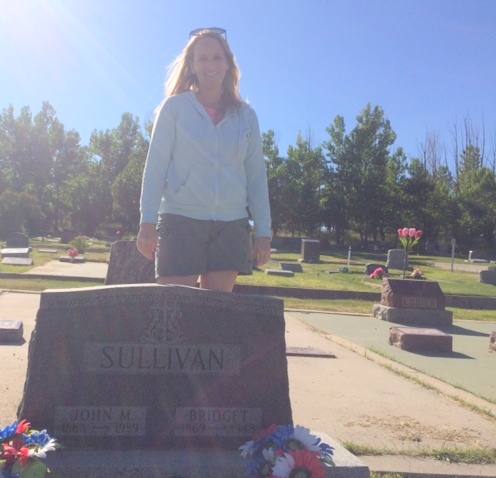
Bridget and John's grave in the foreground

If you want to know more about Bridget, my novel The Murderer's Maid tells the Lizzie Borden story from her point of view.


“Erika Mailman writes a page turner of a thriller that will fascinate as well as terrify….Don’t read this at night; it will give you nightmares.” -New York Journal of Books
“Erika Mailman’s kaleidoscopic narrative melds true crime, historical fiction, and elements of a psychological thriller, all hinging on a singular question: ‘Who isn’t a survivor from the wreckage of childhood?’” -Foreword Reviews
“A complex and riveting parallax view of domestic crimes, decades apart.” -Kirkus
“Those interested in the Lizzie Borden tale…will appreciate Mailman’s research and be rewarded with this new perspective.” -Booklist


. . . . .

Tuesday, July 31, 2018

Bridget Sullivan's grave


My experience of the Lizzie Borden story is through a somewhat different lens than most people; I view it through the eyes of Bridget Sullivan. She was the Irish immigrant maid employed by the Borden family a few years before the murders took place. It is said she tried to quit several times, but Mrs. Borden always talked her into staying. Bridget was at the house the day that Mr. and Mrs. Borden were slain by hatchet, Aug. 4, 1892. The only other person we know was there that day was Lizzie, who underwent trial for her father and stepmother's deaths, and was acquitted. My novel The Murderer's Maid tells the story of these iconic American murders from Bridget’s point of view.

I’m a writer whose had a significant amount of uncanny things happen through her writing. One was writing a novel about witchcraft and then learning my ancestor had undergone witchcraft trials several times. More recently, after my book about Bridget Sullivan came out, my husband’s brother invited us to visit him at his cabin in Montana. What town in Montana?

Oh, it just happens to be the same small town in Montana that Bridget Sullivan settled in, after a hiatus of years in which her trail went temporarily cold. The town is Anaconda.

I had a rare chance last week to visit the grave of my character. She is buried next to her husband John Sullivan (he already had that very common Irish last name, so she didn’t need to change hers, although I guess she could’ve called herself Bridget Sullivan Sullivan). Her side of the shared grave is higher than his, and I fancifully imagined it was her bulky shirts and petticoats causing the difference. Someone had left bouquets of colorful fake flowers on both their graves.

Bridget is on a hill overlooking the town of Anaconda, with a lovely view. She can also see the tower which I think is a smelting tower where her husband would’ve worked. I ran out of time to do that research on this trip, but I hope to return. I’d also really love to connect with Bridget’s great-niece who lives in a nearby town.

So here, a few days before the 126th anniversary of the murders, is a photo of Bridget Sullivan's grave at the Mt. Olivet Cemetery in Anaconda, Montana. Next post: more about the search for Bridget's grave (hint: it wasn't easy, although it should've been).


. . . .


Monday, January 22, 2018

Did Lizzie Borden commit murder naked?


I love how this still is so close you see the texture of their skin. Courtesy, Sundance Review

The reviews for the new Lizzie movie reveal a few interesting things about the plot and its interpretation of the historical events of 1892. For one thing, it utilizes the interesting thought that Lizzie might've murdered her father and stepmother in the nude. Much easier to clean blood off skin than off fabric.

The Elizabeth Montgomery made-for-TV movie of the 1970s used this idea, and seeing the camera dwell on her beautiful calves as she walks towards murder adds a little verve to an already fantastically-rendered movie. Other notable movie moments: Lizzie sneaking down to the dining room where the victims were kept overnight, and lifting the sheet on her father's corpse to...can barely type this....kiss him. And I love it that this movie shows a dispassionate Lizzie, as she was in real life. The only moment where she ever shows horror is for herself, when the attorney forces her to grasp that she may hang for this crime.


But the new movie takes this idea a step further. Not only does Chloe Sevigny disrobe, but Kristen Stewart does too. Lizzie and her Irish maid together strip naked to perform the murders.

Hmmmm.

I have to say, my first thought is a pragmatic one. And kind of a disturbing one.

There just isn't room for two people to commit these murders. Not in the cramped quarters of the Borden home (Mrs. Borden was slain in a narrow alley between bed and dresser) and more definitively, not in the small real estate of where the hatchet blows landed.

The heads, to be exact.

Mrs. Borden had one blow on her upper back, but other that, only the heads bore wounds.

19 blows for Mrs. Borden, and 11 for Mr. Borden a few hours later.

Plaster casts of the Bordens' skulls used as evidence in the trial, now on
display at the Lizzie Borden B&B


If you think about the average head size...and now the average hatchet head size...it would just be awkward for two people to try to murder together. Maybe they each had a hatchet and took turns? I shudder.

I'm not sure how the movie will handle this, but I'm sure fans of both actresses will be happy to see skin. Sevigny told Indiewire, "It’s just a really carnal moment, and I just thought it would be really arresting. I trusted in [director] Craig’s restraint and [cinematographer] Noah’s beautiful photography that they would make me look good. Now I feel extremely vulnerable!" The murder scene was shot on Sevigny's 42nd birthday, and I applaud her bravery in letting loose with what is likely a far more toned body than the average middle-aged woman has!

By the way, Lizzie was 32 at the time of the murders.

And if you want to know about Kristen Stewart (who plays the maid Bridget Sullivan), she is now 27 years old, much closer to the age of the character she plays: 27.

If you want to read my piece about spending the night in the Lizzie Borden B&B, click here. I stayed in Bridget's attic bedroom.


. . . .

Sunday, January 21, 2018

What connects Harry Potter with Lizzie Borden?


Abby Borden and Fiona Shaw
 Why, Fiona Shaw, of course!

This talented actress played Aunt Petunia Dursley in the Harry Potter series, and in the new movie Lizzie (that premiered last night at Sundance) she plays Abby Borden, an elderly woman killed by multiple hatchet blows to the head.

Along with her husband, Andrew Borden.

But they were murdered hours apart (she earlier) and in different rooms of their family home.

Despite a lot of conjecture that a business associate of Andrew's had killed them, suspicion soon arose for Andrew's daughter (Abby's stepdaughter), Lizzie.

Lizzie hated Abby. She and her sister Emma always dined separately from Andrew and Abby, making the poor maid serve and clear every meal twice.

There may be another connection with Harry Potter if you find empathy for Lizzie. Harry was mistreated by his aunt and uncle, slept in a cupboard under the stairs and was always shunted to the background in favor of his cousin Dudley. But Harry had an opportunity to escape all that once he turned 11 and was sent his letter of acceptance from Hogwarts School of Witchcraft and Wizardry.

hellogiggles.com


Lizzie Borden had no such escape route. She begged for a trip to Europe with friends and was granted that. For five months she toured the continent and England and tasted a life of freedom. But soon she was back where she started, in a repressive home in a culture/era that didn't permit women many freedoms. She was able to drive the horse and buggy—but her father sold the horse. Someone broke into the Borden home and, oddly enough, stole trolley tickets. It is said Andrew prevented the police from investigating because he knew the thief was his own daughter.

Lizzie had passed the age of marriage and had her elder sister, still trapped in the house with her, as a cautionary tale of what she might expect in life.

Does it help to know that August 1892, when the murders took place, was a desperately hot month, with multiple deaths from heat being reported to the health department? And that Lizzie and her sister had in the past fought bitterly with their father about property he had deeded to their stepmother's family, and that very recently their beloved seaside home in Swansea was undergoing questions about its dispensation?

Greed. Despair. Lingering pain from childhood when Lizzie and Emma''s biological mother had died. Which is another thing Harry Potter and Lizzie Borden had in common: early loss of one's mother, and how that bereavement can haunt one forever.

Magic saved Harry, but Lizzie had no such savior.

If you find this historical true-crime case interesting, my novel The Murderer's Maid tells the story from the point of view of that maid mentioned above, Bridget Sullivan. And yes, that is the real Lizzie Borden on the cover.


And post in the comments below: what Hogwarts house should Lizzie be sorted into?
. . . . .


Saturday, January 20, 2018

Lizzie Borden's interconnected rooms


The floor plan: no central hallway


I’ve now read a few articles in Filmmaker Magazine that reference “interconnected rooms” on the set of the Borden house. That is so truly integral to the plot, both upstairs and downstairs.

In this piece, “Making a Film is Always a Chaotic Experience,” director Craig McNeill talks about the struggle to find an appropriate house, and concludes, “We found a house that, while different looking than the Borden home, did have several interconnected rooms which was a notable and unusual characteristic of the Borden residence.”

This article features cinematographer Noah Greenberg talking about wanting the film to be “visually elegant and ominous” with characters filmed at the edges of the shot, never centered. I found it to be a really fascinating article.  And Greenberg, too, mentioned the interconnecting rooms:

There were many scenes in Lizzie where we would move through, or see into, several interconnected rooms following a character. With a small lighting package and team and very limited time between setups it was challenge to balance/motivate the light consistently (at a useable stop) across these rooms while keying off practical sources such as a double wick candle held by an actor or an oil lamp on a side table.

All right. So why do those rooms need to flow into each other?

Downstairs: The sitting room where Mr. Borden was killed has doors leading into the front entry, the parlor, the dining room, and the kitchen. Four different ways to enter… and presumably its “fishbowl” type of layout means it would be difficult for a killer to murder him without someone in the house being aware. One of Lizzie’s alibis is that she was in the dining room ironing… well, that was mere feet away and it would simply impossible for such a noisy murder to take place so nearby without her being aware of it. I mean noisy in terms of what the hatchet did to his skull. Mr. Borden himself made no alarms because he was asleep when attacked.

Upstairs bedrooms and that famously winding staircase


Upstairs: the home upstairs is like a “shotgun shack”—you must walk into Lizzie’s bedroom to reach Emma’s and the parents. Although, famously, the door between Lizzie and the parents was nailed shut, and Andrew and Abby Borden used the servant’s stairs to access their chambers. The guest room where Abby was killed leads into Lizzie’s, although there was a desk blocking it.

The home was strange; there’s no doubt about it. It was originally intended as an apartment building, with full living quarters on the bottom and second floors. Andrew converted it to one unit when he took ownership. If you think about feng shui and the energy created by multiple doors flowing into a room and then being blocked, it creates a disturbing sense. Almost like Shirley’s Jackson’s Hill House, where the angles don’t exactly add up to 90 degrees.

It’s a disquieting house. Claustrophobic is the word that springs to my mind most often when I think about it. Small, cramped, enraging.

Chloe coyly sitting where Andrew was murdered (well, on a replica sofa)


I’m disappointed the movie wasn’t shot at the real house. When I visited there last year, there was a photo on display of Chloe Sevigny sitting on Andrew’s sofa and there was great excitement about the upcoming movie (which premiered LAST NIGHT at Sundance!). We were told Chloe had a Lizzie Borden fascination and wanted to film the movie in situ, but because there is a federal building nearby, it created too much of a security hazard for Fall River to agree.

I’m dying to see the movie. I’d love to see how they used the rooms in the house they did locate, and am glad there was awareness of the importance of the rooms flowing into each other.

The Borden House in the Lizzie movie


The real Borden home, today a B&B


I fervently hope this movie gets a distribution deal so I can see it someday soon.


If you want to know more about this story, my novel was written from the maid's point of view--Bridget Sullivan was the only other person in the house the day of the murders, besides Lizzie and the victims.


. . . .

Wednesday, January 17, 2018

Bridget the maid was the first to finger Lizzie Borden


The sofa upon which Mr. Borden took his endless nap


In all the hullabaloo of a proper, elderly man being found slaughtered on his own sitting room sofa, and then not too long later, intrepid women climbing the stairs to find his wife on the floor in a similar state, no one thought to ask Lizzie Borden about her possible role in all this.

Not until Irish maid Bridget Sullivan innocently—or not so innocently—asked, “Miss Lizzie, where were you?” *

Can you imagine how quickly eyes must’ve flown to Lizzie’s face? In the house by this point were several neighbors, friends, and a doctor. I loved the simplicity of this phrase so much that I used it verbatim in my novel.

Attorney Moody and Jay Huguley, who plays him in the upcoming movie Lizzie


At trial, in his opening statement William Moody spoke about this moment. He said Lizzie’s response to Bridget’s question was, “I was out in the back yard, I heard a groan, came in and found the door open and found my father.”

The neighbor Mrs. Churchill saw Bridget out of her window running to fetch the doctor, and she came over to learn more. When she asked Lizzie the same question, Lizzie told her, “I was out in the barn. I was going for a piece of iron when I heard a distress noise, came in and found the door open, and found my father dead.”

After her best friend Alice Russell was fetched by Bridget, Lizzie told her that she was in the barn for a piece of iron or tin to fix a screen (window or door screen).

Moody summed it up nicely:

There is therefore, Bridget Sullivan, to whom she said that she heard a groan, rushed in and found her father; Mrs. Churchill, towhom she said she heard a distress noise, came in and found her father; Officer Mulally, to whom she said she heard a peculiar noise like a scraping, came in and found her father dead; and all those, gentleman, you see in substance are stories which include the fact that while she was outside, she heard some alarming noise which caused her to rush in and discover the homicide.

Well, that sounds decent. She wasn’t clear on the sound, but all the stories contain the same general idea. Innocent!

But wait. Moody went on.

You will find that when she gave a later and detailed account, she said that she went into the loft of the barn, opened the window, ate some pears up there, looked over the leader for some sinkers [for a fishing line], came down, looked into the stove to see if the fire was hot enough that she might go on with her ironing, found it was not, put her hat down, started to go upstairs to await the fire which Bridget was to build for the noonday, and discovered her father. It is not, gentlemen, and I pray your attention to it, a difference of words here. In the one case the statement is that she was alarmed by the noise of the homicide. In the other case the statement is that she came coolly, deliberately about her business…and accidentally discovered the homicide as she went upstairs.

Window screens, fishing lures, pears, haylofts, ironing handkerchiefs…it all sounds like a fever dream.

Kitchen cabinets adorned with pears at the Lizzie Borden B&B


And does it help to know this was a ridiculously hot day in August (people had been dying of the heat), and that lingering in a hot loft to eat pears doesn’t sound plausible?

I love reading the old trial testimony, the antiquated syntax. All very pleasurable to me.

And on a final note, given the news that the Chloe Sevigny and Kristen Stewart movie soon to be shown at Sundance may cast these two as lovers, the title of my post may have a special double meaning… I leave it to you to decide.
UPDATE: Based on the movie trailer that launched August 3, 2018 (the day before the murder anniversary), they are definitely cast as lovers!

*Footnote: Bridget asked this question of Lizzie immediately, but it was more fun for the blog post to start this way.