Monday, January 23, 2017

Dost hear that, yolk devils? My review of The Witch


Thomasin and Caleb at the brook

*** quite atrocious spoilers be found in this review ***

My sister was here visiting the week before Christmas, and we decided to do the very Victorian thing of indulging in a ghost story for the holidays. The idea of the movie The Witch appealed greatly to us. We are the descendants of Mary Bliss Parsons, who faced trial for witchcraft in Massachusetts in 1656 and again in 1674, decades before the Salem hysteria. She was found innocent both times. I'm also the author of The Witch's Trinity, a novel about medieval witchcraft—in fact, it was uncannily during the course of writing the novel that my mother learned of our connection to Mary Bliss Parsons.

We settled down to watch while my husband settled the kids to bed. We kept the sound low to not drift up to them, and I'll readily admit we have an elderly television, but even so it was astonishing how much of the movie we could not hear.

As in, we basically could have turned the sound off and gotten roughly the same amount of information.

It is not an exaggeration to say it was as if we watched a silent film with some atmospheric music and a bit of dialogue here and there.

We would periodically pause the movie and confer with each other about what we'd gleaned, like archeologists trying to reconstruct a pot out of potsherds. A typical exchange:

Sister: So, the mom thinks Thomasina stole her silver cup.
Me: Oh! Wow. I totally didn't get that.

We thought her name was Thomasina throughout the whole movie because we just couldn't hear.

Although I'm sure in real life, the actor who plays the father is considered to have a majestic voice, in this setting it registered as Grendel with a head cold.

The visuals were splendid enough to keep us going although I did ask my sister if she wanted to continue and she kind of shrugged. As the movie came to a close and the screen blacked out, I said to her, "If the credits start to roll now, I'm going to give the finger to the screen." The credits rolled, and I flipped the bird.

"That was pretty bad," she said. I felt doubly guilty because the night before, my husband had inflicted The Great Muppet Caper Movie on all of us.

She went to bed disgruntled, and I went to imdb and wikipedia to figure out what the heck we'd missed.

It turned out: a lot. Funnily enough, the dialogue actually was an important conveyor of plot!

I told her in the morning what I'd learned and we both decided we'd like to watch it again sometime with closed captioning turned on.

Part Two

Fast forward a few weeks. I watched the movie again on Friday the 13th (of January) with captions turned on. I watched on my Kindle screen in bed.

The movie vastly improved, but still feels like it didn't accomplish everything it might've. As a person whose creative work is reviewed online, I know how much a review can sting (right now on Amazon, the first review in the queue for one of my novels is one-star and says nothing more than "Awful"). So I apologize in advance, and will add that I feel the acting in this movie was superb. Every single actor was riveting, credible. The cinematography was incredible, the costuming and sets powerful, I'm not sure how to judge directing, but that seemed very well done too! I think the weak link here was the script.

Things the script did right:
  • Authentically conveyed the language of people newly arrived from England to the New World
  • Created timed suspense over secrets family members had been keeping from each other (the precious cup, the idea of placing Thomasin with another family)
  • Authentically conveyed a family working together to create subsistence in a harsh environment

Things the script could've done better:
Created more horror.

When I think about narrative arc, it's about introducing trouble, which builds and builds until some climactic event happens. In this movie, the worst thing that happens takes place in the first eight minutes.

Where do we go from there? There's quite literally nothing worse than that old woman using her child-sized mortar and pestle. Or the way her hands travel over his naked body (disturbing on multiple levels) before the knife glints in the shot.

Worse, we know right away that there are witches. This is not a story the baby comes back and tells the family—we see it as "objective" observers, and thus it must be true and must be happening.

I was thinking, what if the two abductions of the story were reversed? Caleb disappears first, and we can still see the transformed woman beckoning him into her embrace, but we can wonder if he is really seeing what he thinks he is. It would create a helpful ambiguity. Maybe he's eaten ergot bread or is growing into mental imbalance as well as puberty...

Then, if the baby disappeared after Caleb, we would have some sort of reference point for what we feared would happen to him: and then what really does would leave us far more shocked and upset.

And by the way, the shot of the seductive woman embracing Caleb: it was unclear to me whether the crone's arm that grabs him was her arm or that of someone standing behind her. If the former, the angle was a little off somehow.

Mother and twins, Thomasin in the background


Questions the movie didn't answer for me even upon two viewings:
1. Did the family come across an already-existing farm or build one? They first survey an empty field in front of the "evil tree" but when we next see the complex, the viewpoint has changed, so it's unclear whether it was built on the same stretch of land. If the farm was already built, there's some instant backstory about whether this evil property continues a cycle of luring in settlers. But (thinking aloud here), I think the plantation in the beginning that expels them must've been Plimouth, and therefore there probably weren't too many other folks preceding them into the wilderness.

2. What is the thinking with that tree? Source of power? Source of broomsticks? It features menacingly in several shots, but we don't learn why it is a "featured" tree.

3. What happened to the twins? At the end, the shed has been ripped apart and the two goats (other than Black Philip) lie half-eaten. I don't know if the children were abducted like Caleb was (for what purpose, then?) or like the baby was (aren't they too old to be flying ointment material?). I wondered if Thomasin would find them at the witch's cabal but it looked to be only grown women there.

4. Why would Thomasin accept the offer of an entity that killed everyone in her family? I'd need to see some proof of that "living deliciously" because it kind of seemed like the witch (es?) lived in a nasty little hovel.

I liked thinking about what would have happened if the mother had succeeded in strangling Thomasin. Would she then be offered the book to sign and the chance to join the cabal in the woods? I assume, though, that Thomasin was selected because of her beauty and nubility.

Continuity: We never see Thomasin clean her face but when she awakes there is no blood around her mouth, only on her neck and chest.

This movie takes all the ignorant, superstitious things people believed about witches back then and made them true. I'm sure some women and men who faced the noose or the stake are spinning in their graves right now.

I didn't find the movie scary but I found it somewhat haunting; it's a compliment that I wanted to watch it a second time. I loved its promise, and I wish it could've offered a stronger build-up of tension and mounting horror.

The title of my post comes from movie dialogue: I thought it was pretty awesome. That's what the father calls the twins when he suspects they may be witches.


. . . .


Saturday, January 14, 2017

Five Interesting Facts about Lizzie Borden


Lizzie on the left, Chloe Sevigny on the right

1. She was very active in the church.

An avid volunteer at the First Congregational Church, Lizzie served on the Ladies' Fruit & Flower Mission (organized to take fruit and flowers to sick people in hospitals or at home) and the Women's Christian Temperance Union (anti-alcohol). She also taught Sunday School, including to young Chinese boys who were the sons of immigrants. 

Is it any wonder the jury had a hard time seeing this diligently benevolent woman as a murderer? It must've been a long con.


2. She had a taste of the good life.

Two years before the brutal murders of her father and stepmother, Lizzie took a "Grand Tour" of Europe with some distant cousins. She was gone for a full 19 weeks, from June 21 to November 1 of 1890. Probably a wonderful time in which the household in Fall River took a few, calming deep breaths, while she witnessed the wonders of the Continent and the British/Irish isles. 

Lizzie's scrapbook of this visit, replete with photographs pasted in and her careful writing beneath, still exists in the archives of the Fall River Historical Society. Of course, it must've been difficult to settle back into her narrow life when she returned: no more of the grandeur of museums and statuary.

April 1912 (22 years after Lizzie was there).


3. She was bossy.

Multiple accounts exist of her being proud, haughty, and willing to speak her mind. Once she returned from the Grand Tour, she had so many souvenirs and gew-gaws to display, that she and her older sister Emma swapped bedrooms. It's important to note that one larger bedroom funneled into a smaller one—almost as if the second bedroom were a closet to the first. Lizzie had traditionally slept in the smaller room, but somehow a change was effected after her return. Did Emma offer, or did Lizzie demand? 

Gimme your room! And this chair!


4. She loved animals.

The largest bequest in Lizzie's will was to the Fall River Animal Rescue League ($30,000 in 1927 dollars!). She was known to love and cherish the pets she had after the murders; there is no mention of pets beforehand. Was part of the "problem" that she wasn't allowed to keep a dog in the house? Lizzie ordered expensive, carved tombstones for her dogs. 

And of course: the pigeons. Lizzie kept pet pigeons in the family barn. Two months before the murders, her father killed them all because neighbor boys had been breaking into the barn to mess with them. Apparently, her father hadn't understood the sentimental value and care she lavished on them (or did he?) Was the pigeon slaughter just one more straw that was put upon the proverbial camel's back?

No...don't...it hurts... [from thriveumc.org]


5. It is possible she tried to poison the family.

Eli Bence, a druggist in Fall River, tried to testify that he had seen Lizzie try to purchase prussic acid (click link for more on this), but his information was suppressed during the trial. When was she trying to buy this poison, more commonly known as cyanide? Oh...just THE DAY BEFORE THE MURDERS. 

In writing The Murderer's Maid (my novel about Lizzie Borden from the maid's point of view), I had to decide how to tackle this sticky issue. Did she really try to purchase poison? Why did the judges (three of them!) decide the jury shouldn't hear Bence's testimony? And isn't it interesting that in the days before the murders, the entire household was vomiting, and Mrs. Borden even told the doctor she thought someone was trying to poison them? 

Typical drugstore of the era


I get tense just typing all this, want to go back in time and throttle the judges! Ha ha. This is when history is at its best, when our emotions get caught up in it. 

If you enjoyed this post, you may wish to read Five Interesting Facts About the Real Bridget Sullivan. You may also wish to read my novel based on the case:


Buy links for the Murderer's Maid are here:


. . . . .

My other historical novels:


A medieval German woman is accused of witchcraft by her own daughter-in-law.
"A well-constructed novel and a gripping, well-told story of faith and truth."
           —Khaled Hosseini, international bestselling author of The Kite Runner
“Beautifully written, nary a word out of place, and with a few moments that throw you beyond—the way good books do.”
           —San Francisco Chronicle
A San Francisco Chronicle Notable Book of 2007


Buy links for The Witch's Trinity:


A Boston prostitute shows up in San Francisco at the very beginnings of the Gold Rush, and quickly learns she's in dangerous territory with a killer targeting her kind.
"LOVED Woman of Ill Fame! Nora Simms is hilarious, heartbreaking, tough, perceptive...
and one of the most engaging characters I've ever met between the pages of a book." 
                   Diana Gabaldon, author of Outlander, now a Starz miniseries
"Mailman serves up vivid description, sparkling prose and a Gold Rush prostitute as scrappy as Scarlett O’Hara."
                    Oakland Tribune

Buy link for Woman of Ill Fame ebook:


 . . . .

Wednesday, January 11, 2017

Five Interesting Facts about the real Bridget Sullivan, maid to Lizzie Borden


The real Bridget on the right, Kristen Stewart on the left

1. She was restless.

Bridget moved to the U.S. from Ireland in 1886. For the next two years, she lived in three different states: Rhode Island, Pennsylvania and Massachusetts. Quite a lot of traveling for a young immigrant in her early 20s. Even within the small town of Fall River, Massachusetts, she worked for two other families before coming to be the Borden family maid in 1889.


2. She tried to quit.

Bridget was unhappy at the Borden household and tried several times to end her employment. It is said Mrs. Borden begged her to stay and raised her wages.

Abby welcomed Bridget's presence in the tense household


3. She knew more than she said.

The prosecuting attorney Hosea Knowlton always thought Bridget had something to do with the murders, or at least had incriminating information she was holding back.

Suspicious Hosea Knowlton


4. She had a strong brogue.

Bridget's Irish accent was so deep that at times during Lizzie Borden's trial she was not understood. In particular, when she spoke of "keys," it was thought she was saying "case."


5. She had a nickname

Whether Bridget welcomed it or not, Lizzie called her "Maggie," the name of a previous maid. Was it Lizzie being sloppy, finding it too darn difficult to learn a new name, or was she being affectionate? Was it meant to be demeaning? Bridget claimed in court that she didn't mind being called Maggie, but a person's name is one of the most profound and integral parts of their identity.


. . .
This is just a teaser. Want to hear more? Want to know what ordeals Bridget faced in that terrible, tense household? My novel  The Murderer's Maid: a Novel of Lizzie Borden tells the story from Bridget's point of view, with a lot of facts and a little fiction.


Order it here:


Some of my other historical fiction:


. . .

Saturday, December 31, 2016

Want a guide to help you write a better novel?


Isn't this cover design stunning?
 
I wanted to let readers know of a wonderful book on the craft of writing, Jordan Rosenfeld's
Writing the Intimate Character: Creating Unique, Compelling Characters Through Mastery 
of Point of View. Out in October from Writer's Digest Books, the book includes incredible 
advice for writers, and I've been enjoying reading it because of its wit and incisiveness. 
It's inspiring, it spurs motion for writers, and delivers analysis of a tricky issue (point of 
view) that breaks it down into understandable components.
 
Jordan and I did a quick interview over email and I'm happy to share it with 
you here.
 
Q: You've had great success with your Writer's Digest books. What's the
best piece of feedback you got in response to one of them? Did anyone have
a breakthrough or reach new understanding because of reading your words?
 
Jordan: The two biggest compliments I've received are for Make a Scene and A
Writer's Guide to Persistence. Several people have called Make a Scene
their "writing bible" and many have said it has changed their understanding
of scenes. However, I've been most moved by the comments on Persistence,
like a 70 year old woman who heard me talk at a Writer's Digest conference
and came to me, crying after, to say she had all but given up on her
writing and now she knew it wasn't too late, that she could still write for
herself, no matter the outcome.
 
Q: What's the best piece of advice in your latest book?
 
Jordan: In Writing the Intimate Character, the best piece of advice is most likely
to remember that the best way to demonstrate all character experience, as
well as their point of view, is through sensory experiences: that is, how
do emotions and experiences feel in the body? Can you use all the senses,
plus images, to show the reader fear, for example, as something writhing in
a person's chest, rather than saying "he was mad." 
 
Q: Who do you think is the best audience for your latest book?
 
Jordan: Absolutely anyone who wants a better understanding of point of view and how
to develop strong characters. 
 
That's pretty much any writer, at any stage of development and experience. I found much 
to learn from with this book and highly recommend it! Jordan's had a fantastic career of 
teaching writing and writing craft books that distill her knowledge into fun and likeable 
books. Her voice is friendly and instructive, and draws you in.
 
Jordan Rosenfeld is the author of seven books, most recently the novel Women in Red and 
the writing guide Writing the Intimate Character. Her freelance work has appeared in 
such places as The Atlantic, New York Times, Salon, Scientific American, The Washington 
Post and more.

Order Writing the Intimate Character by clicking on the image below. And: Happy New Year!


Friday, December 30, 2016

A diptych is worth 2,000 words

Here are the actors in the upcoming Lizzie Borden movie, paired with their historical counterparts.

Lizzie and Chloë Sevigny


Bridget Sullivan (the Borden maid) and Kristen Stewart


Abby Borden and Fiona Shaw


Andrew Borden and Jamey Sheridan


Kim Dickens and Emma Borden. Emma was Lizzie's sister. Absent the day of the murders, she was sent a telegram that her father was very ill because it was thought the real news was too shocking to be delivered in that manner. Subsequently, she delayed returning to town until the evening, only to learn he had actually been hatcheted to death, and her stepmother too.

Welcome home.

Kim Dickens in L.A. Times


Jay Huguley and William Moody (junior prosecuting attorney trying to get Lizzie convicted, with Attorney Knowlton)


And Jody Matzer plays Officer Fleet of the Fall River Police Department:

Another character I'm very keen on learning the actor for: Alice Russell. She was the friend Lizzie called for after the murders (rather than, oh say, the police).


. . . .

Don't forget to follow this blog (scroll down or see column on right-hand side) and/or follow me on Twitter (@ErikaMailman) to keep up with news on this movie as I hear about it and read posts about the historical Lizzie Borden. My book The Murderer's Maid is now out in the world. As of this update (Jan. 2018) the book is on the front "new fiction" tables at selected Barnes & Nobles nationally. Or see the links below the book jacket to order.


Other historical novels I've written. To learn more, visit my official website.


. . . .

Tuesday, December 27, 2016

More about the Lizzie Borden movie

I understand filming wrapped before the holidays in Savannah, Georgia, and that the film is to be released "sometime in 2017." I for one cannot wait. Just the idea of sitting in a movie theater watching the trailer gets me all excited!

A few fun things to add: looking at a map of Fall River, Massachusetts (where the Borden murders took place), I saw that one of the streets leading to the cemetery where Lizzie and her family are buried is called Sevigny Street. Coincidence?? I've heard Chloe Sevigny--who plays Lizzie--has an interest/fascination in the story. Is it because relatives of hers lived in Fall River?

This photograph of Chloe sitting on the sofa (not the original, but very close to it visually) where Andrew Borden died can be found on the wall of the gift shop at the Lizzie Borden Bed & Breakfast. Whaaa....t? You didn't know the murder house is actually a themed B&B? It is. I stayed there last summer in the attic bedroom of Bridget Sullivan--the character whose point of view I chose for my novel The Murderer's Maid, coming out in October 2017--and will blog about that in detail later.


This picture of the movie set came from Twitter (#Lizziethemovie), and you can see how very closely the set conforms to the actual room. Or actually, maybe you can't because the photos are taken from two different angles. EPIPHANY: Okay, actually as I'm blogging, I'm realizing this MUST be a picture from the actual home, because in the distance you see faucets on the sink. That wouldn't be the case with a period set, but is indeed the case with the true house, because after the murders a series of real people lived in it and ate in it and required modern appliances.


Okay, this one I know for SURE is the movie set, because it bears no resemblance to the actual house in Fall River.


Here's the actual house in Fall River. What's interesting to me is that the movie house is far more grand, because the family's money (wealthy) and Lizzie's access to it (restricted) forms quite a bit of a murder motive. Lizzie desperately wanted to be successful in society, hold grand parties, entertain...but her father wouldn't let her, and the house was in a part of town looked down upon (literally) by fancier hills residents.

Next door even lived Irish people (shudder!), who were considered low-class at the time. After Andrew Borden's body was discovered, the Irish maid Bridget was sent to fetch Dr. Bowen across the street....because every clearly-mutilated corpse deserves to have its absent pulse noted....when he wasn't there, instead of getting Dr. Kelly who was right next door, Lizzie instead sent Bridget to get her friend. Why not Dr. Kelly? He was Irish. And why no police? Because she was guilty. ;)

Speaking of Bridget, she's played in the movie by Kristen Stewart. She's a fantastic choice, and I can't wait to hear if her Irish accent is an authentic brogue. Stewart is 26 years old, as was Bridget at the time of the murders. Kismet? Interestingly, I just reread a section of the trial transcripts where Bridget reveals she doesn't know when her birthday is. How strange that is...so much of our identity is wrapped up in our births and celebrating that day. Maybe I'll invent a birthday for Bridget and start celebrating it in some weird way.


Kristen Stewart on set as Bridget Sullivan, Lizzie's maid

Lizzie was 32 at the time of the murders, and Chloe is 42, but of course Lizzie didn't have access to wonderful aesthetician creams, so looks far older than lovely Chloe.

Let's see...I also saw a photograph of a seaside home on the Twitter page, which excited me because it looks like this movie is trying to cover the historically-accurate bases.


This could be a photo of the seaside cottage at Marion, a trip Lizzie was supposed to take with her girlfriends--and instead was at home on a hot August day when her father and stepmother were murdered. More likely, however, it's a picture of the Swansea home, where she and her family vacationed. It was a meaningful house sentimentally, but there is evidence that her father was about to sell it, putting it in her stepmother's name, just days before the murders. A previous example of Mr. Borden putting a home in his wife's name led to incredible angst within the household--so angsty that Lizzie stopped calling her stepmother "Mother," as she had done for nearly three decades, and instead called her Mrs. Borden until the time of her death. So: motive motive motive.  Kudos to the filmmakers for getting this right. I can't wait to read the script sometime.

And of course...watch the movie.

I'll continue to blog about Lizzie Borden and anything I hear about the movie in progress. Please follow my blog if you want more updates; see the sign-up in the right hand column when you scroll down. 

. . . .


Sunday, December 11, 2016

The Harry Potter-Lizzie Borden connection

Fiona Shaw


It's not the Bertie Botts Every Flavour Beans, although we know Lizzie did enjoy the many candies sent to her in jail as she awaited trial.

The real Abby Borden


No, the connection is that while the Lizzie Borden movie is filming in Savannah, Georgia, Daniel Radcliffe is in town filming something else AND I just learned that Fiona Shaw, who played Harry Potter's cruel Aunt Petunia, will portray Abby Borden.

Yes, she is Lizzie's stepmother, who will be brutally murdered.

Abby Borden was said to be very stout, at 180 pounds, so lovely slim Fiona will have to eat more of those beans. She was also 64 at the time of her murder. Ah well, Hollywood is fun in that it "adjusts" things for us. Maybe Shaw's Abby will fight back and grab the hatchet and chase the killer down Second Street.

The family maid, Bridget Sullivan, said a few weeks after the murders that Abby "was treated badly by Lizzie and [her sister] Emma...and particularly by Lizzie." She said that Abby "was too good for them and they did not like her."

Abby had been stepmother to the two girls since Emma was 14 and Lizzie a mere five. In fact, up until just a few years before the murders, the middle-aged Lizzie called Abby "Mother." A money-based dispute led to her suddenly calling her Mrs. Borden instead.

Bridget reported that the sisters never ate meals with the elder Bordens; it was a household divided. And on a hot August morning, someone was pushed too far, and blood was spilled.


. . . .


Saturday, December 10, 2016

Timberline's true name

For those of you coming to this blog because of the Book Bub promotion, I wanted to repost something about the woman depicted on the cover of Woman of Ill Fame.


Timberline's True Name


--This is a reposting; I know there is renewed interest in Woman of Ill Fame and so I'm going to put this blog post up again.


This blog is currently about witchcraft persecutions, ancient and modern, but now and then I will dip into material regarding my first novel Woman of Ill Fame. The novel is about a Gold Rush prostitute in a dangerous, brand-new San Francisco.

A few days ago, someone was in my archives and saw my post about the real-life prostitute whose image is featured on the cover. All I knew was that her name was Timberline, she was a Dodge City prostitute, and her image is in the collections of the Kansas State Historical Society.

Well, the anonymous commenter wrote that her name was Rose Vastine.

That for one thing totally threw me. Although I fashioned my character based on this photograph and named her Nora, for some reason I had “felt” that this real woman’s name was Kate.

Secondly, the commenter wrote that she earned the name Timberline for being 6’2” in height. Another big surprise. In my mind, the nickname had dirty connotations!

Armed with her real name, I consulted Professor Google.

The first link I accessed made me gasp out loud in the café I was working in, and literally grab my forehead. According to Linda Wommack’s Ladies of the Tenderloin, “Timberline climbed up into the hills above Creede and shot herself not once, but six times.”

When you have spent so much time staring at someone’s photograph and constructing an entire novel around them, you develop a strange and intense connection to them. It was almost as upsetting as hearing this news about someone I knew…but not only was Timberline a stranger to me, but she died 150 years ago. Whatever sorrows she endured, they are dust now.

I had dedicated the novel to two wonderful women the world lost at an early age, and on the second line dedicated it to “Timberline and the other girls of the line: I hope the world was kind to you.”

And here was evidence that the world had not been kind to her.

The link went on to say that Timberline did not die from that suicide attempt, but strangely enough, another link had her recovering from an “intended overdose.” Is it apocryphal that she tried to kill herself with such vastly different methods and survived both times? Whatever the truth is, she must have been an unhappy young woman.

Several sources have her living in Creede, Colorado, a silver mining camp 420 miles from the Dodge City that her photograph is labeled with. Sure enough, the website for Creede, Colorado mentions Timberline on its “About Creede” page. Bat Masterson too (whose biography the commenter mentions) lived in both cities, so maybe she hitched a ride with him.

If anyone has any more information on her, I’d most definitely love to know it.

. . . . .

Thursday, December 08, 2016

Woman of Ill Fame ebook sale

The Woman of Ill Fame ebook is on a Book Bub promotion Dec. 9-14 for only $1.99. If anything says "the holidays" more than a Gold Rush prostitute learning a serial killer's after her, I'd like to hear what it is! Check Amazon or B&N Nook to get your copy.


Monday, December 05, 2016

Lizzie: the movie

It's so exciting to know that the Lizzie movie is filming right now in Savannah, Georgia! Twitter is slowly seeping wonderful photographs from the set and I'll share some below. Apparently, Daniel Radcliffe is also in town filming something else; kind of fun to think of him, Kristen Stewart and Chloe Sevigny hanging out lifting a glass at the end of the day shooting.

Expelliarmus?


Another exciting announcement comes from Publisher's Marketplace.
November 18, 2016 - THE MURDERER'S MAID by Erika Mailman
Fiction: General/Other
Bram Stoker finalist for THE WITCH'S TRINITY Erika Mailman's THE MURDERER'S MAID, in which a young woman tries to stay one step ahead of a mysterious stalker and learns she has a connection to the infamous Lizzie Borden, accused of murdering her father and stepmother with a hatchet in 1892, to Lisa McGuinness at Yellow Pear Press, in a nice deal.

I'm delighted that I'll get to see my main character*, Bridget Sullivan, the Borden family maid, depicted on the big screen by Kristen Stewart. Here's imdb's article about the as-yet-unnamed film.

*It's important to note that the movie filming now is NOT based on my novel or screenplay, but is coincidentally on the same beloved topic.

or maybe the film is titled: "Lizzie?"


My book will launch on Halloween 2017, and I'm hopeful it will coincide with the film's release. The Lizzie Borden narrative is worthy of scrutiny, as it has a lot to say about the lives of women in that era (for instance, the jury didn't believe it possible that a woman could be capable of such violence, and in fact no woman was allowed to sit on her jury). The frustrations of someone outside of society, unmarried, angry, un-air-conditioned (don't laugh, but Lizzie's town was undergoing a massive heat wave at the time of the murders)...it's all a fascinating look at a bygone era.

A penetrating glance from Chloe Sevigny...compare to the real Lizzie, below


Meanwhile, enjoy these sneak peeks into the upcoming movie!

The Borden house for the movie

Texting her employer, "I still think you're innocent."


. . . .


Monday, November 28, 2016

Is Frozen Charlotte Lizzie Borden's doll?


Was this Lizzie's doll?


While at the Lizzie Borden Bed & Breakfast, I spied a doll in a glass case behind the cash register in the gift shop. Turns out it was a Frozen Charlotte doll that had been found in a privy excavation along with other shattered bits of crockery and bottles. An employee kindly took it off the wall so I could look at it more closely. Conjecture of course has it as Lizzie Borden's doll since she was the only child living there around the time the dolls were manufactured (1850-1920 or thereabouts).

Item reflected in her glass case: a hatchet windchime with blood "droplets"
(hanging upside down in this view)


Lizzie was born in 1860 and moved to the Second Street house in 1872 when she was 12. Is it possible the doll was given her when she was younger, moved with her to the house, and was discarded in the privy after the arms and one leg were broken? It is entirely possible Lizzie (or even her sister Emma) kept the doll well past the age one would play with a doll, because of its sentimental value. It may have been a gift from their birth mother Sarah Morse. Sarah died when Lizzie was 3 and Emma 12. In that circumstance, however, you would think you would keep the doll even in its broken state. It's hard to know what the story behind this enigmatic piece is.

A quick bit of online research reveals that the bisque dolls were called Frozen Charlottes because they were frozen in one piece, without moveable limbs. No fun to dress them! Apparently they became allied with a sad poem and then ballad from the era, "A Corpse Going to a Ball," by Seba Smith. Among other things, Smith coined the word "scrumptious" and wrote the terrible saying, "There's more than one way to skin a cat."

Exhibit of items taken from the privy excavation


No surprise, then, that he wrote a poem based on the true 1840 story of a young woman riding to a New Year's Eve ball in an open sleigh, who didn't want to cover her beautiful dress. At first Charlotte complains to her husband about the cold, then later she talks of growing warmer. After ten miles of shivering, she died of hypothermia.

Here's a few stanzas from the poem:

...Her bonnet and her gloves were on,
she stepped into the sleigh,
Rode swiftly down the mountainside
and o'er the hills away;
With muffled face and silent lips,
five miles at length were passed,
When Charles with few and shivering words,
the silence broke at last.

"Such a dreadful night I never saw,
the reins I scarce can hold."
Fair Charlotte shivering faintly said,
"I am exceeding cold."
He cracked his whip, he urged his steed
much faster than before,
And thus five other dreary miles
in silence were passed o'er.

Said Charles, "How fast the shivering ice
is gathering on my brow."
And Charlotte still more faintly said,
"I'm growing warmer now."
So on they rode through frosty air
and glittering cold starlight,
Until at last the village lamps
and the ballroom came in sight...

What a great toy for a kid! A woman frozen for her vanity.


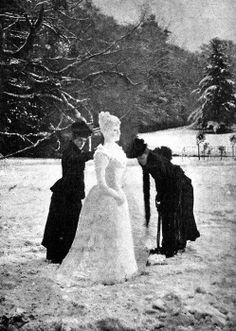
Wish I knew more about this striking image I found online


Kind of a new twist on "Stopping by Woods on a Snowy Evening."

You can still purchase these dolls on ebay or maybe find some buried in your backyard. One more fun element about the dolls; some of them have unglazed backs so that they can float in the bathtub. Apparently people sometimes baked the smaller ones into cakes. Yum, tasty corpse in my red velvet slice! And, true to Victorian sensibilities, some came with their own coffin.


. . . .